-
Author
Zoe Black -
Date
8 Jul 2026
Essay
He maramara tupu aranga: Chips fly, something takes form
It was a perfect clear day when I first spent time with Carin Wilson at Pukeruru, the kāinga that he designed and built overlooking Wairahi Langs Beach in Te Tai Tokerau. We spoke about his practice through the furniture pieces that fill this home. His whare is an archive of his career, each item imbued with stories of different moments, collaborators and design problems resolved through persistent experimentation.
We also spent time in his studio and there I witnessed the depth of energy of his approach to craft. The studio is where his ideas take form, eyes gleaming with possibility, hands continuously exploring pieces of timber to feel out what they want to become. Every surface of the space holds remnants of the 50 years of his practice – posters, manifesto, invitations to exhibition openings, flags, photos, song lyrics jotted down. A full and beautiful life on display.
In preparation for this kaupapa I spent time digging into Wilson’s archives – uncovering other aspects of his life was a daily occurrence. I discovered the outrageous Lair for a Lounge Lizard (1988), a cheeky piece of furniture for the modern socialite, constructed around an old car seat. There was the stunning He Nehenehe (1993), a chair commissioned by the Ministry of Forestry to promote investment in New Zealand-grown pine. Come Sit with Me (1991), a curvaceous sofa that Wilson made for his daughter and her boyfriend to nestle in.
There were countless reports and lectures, expounding on the importance of craft education and how it should be embedded in all schooling, amplified as much as sports and mathematics. There were hundreds of articles, letters and opinion pieces in publications that fuelled dynamic kōrero across the craft community, urging more value to be given to the handmade.
At one of the entrances to his studio, a sign carved in maire states ‘Toi te kupu, Toi te mana, Toi te whenua’. Just one indication of the responsibility he shows in his mahi to his whakapapa and a deep focus on uplifting tangata Māori. This manifests not just in the work he fabricates but in his unwavering attention to kaupapa that advocate for more visibility for Māori worldviews.
When we began discussing the exhibition title, he sent me an email offering: ‘I’m operating in a transcendent and spontaneous level of conception-function-resolution where multiple dimensions of self are all engaged and having a great party. I’m sure we can figure out how to say that in a few words.’ I think we did in the final title, as it captures the intuitive and expansive way Wilson works: he maramara tupu aranga – chips fly, something takes form. However, to adequately show Wilson’s expansive practice in Objectspace’s 12-by-12-metre gallery was an impossibility – there are too many kaupapa, collaborations, side quests and spontaneous projects. To spend time with Wilson is to understand someone led by perpetual discovery, incessant energy and ambitious determination. He approaches his life and his making with the same vitality – urging himself, his whānau, collaborators and audience to all extend beyond the initial intention and into the monumental.
—
There is an important anecdote from Wilson’s career origin story. He had bought his first home with wife Jenney and they had no money for furniture. Wilson found a discarded timber gate under the back hedge and repurposed it to build some things for their house. The spark he felt giving a new life to this timber was a catalyst for a career pivot. Wilson was studying law but realised that he wanted to make things instead – to build the desk, rather than sit at it. So, he left law school and, in the early 1970s, found a supportive cohort of artists and woodturners in Ōtautahi Christchurch. A workshop was formed off Montreal Street and Wilson began making furniture from locally sourced timber. He held his first exhibition in 1974 at the Canterbury Building Centre and sold out after local retailers McKenzie & Willis purchased the entire collection. He then joined James Pocock under the name Adsmarc, and together they produced heavily adzed chairs and tables, as a protest against generic store furniture.
Wilson recalls this as an extraordinarily fruitful time that defined some of the values that remain constant in his practice – considering how form and function must align with an overarching obligation to respect the essence and mauri of timber. He wrote: ‘I can only conclude that the lurking affinity I have for timber is from my origins, particularly my Māori whakapapa. Māori carvers have a deep spiritual understanding of rākau and the mauri within it.’
In 1982, following a study grant to research international craft practice and education, he relocated to Tāmaki Makaurau with his whānau and his studio in Maungawhau Mount Eden was established. The study grant enabled Wilson to see the value of craft education and skills-based learning in other parts of the world, and this prompted him to work with the Crafts Council of New Zealand to campaign for the same standards in Aotearoa. He became president of the council (a position held for three years) while continuing to advocate and offer reports and commentary for strengthening creative education at all levels of learning.
Parallel to this mahi, Wilson was actively exhibiting furniture in Tāmaki Makaurau and in 1987 joined a group of other designers to present Artiture, an exhibition of contemporary Aotearoa furniture. With annual exhibitions over seven years and one international tour in Japan, Artiture was a wildly popular and innovative series. It made a lasting impact in how the public viewed contemporary furniture and offered designers a chance to tease out just what Aotearoa design was. At the time, Wilson described the style as one that drew from Pacific and Māori aesthetics and materials but with a view to the future. ‘We’re fortunate enough to live on these islands in this kind of splendid isolation, a splendid isolation that gives us a chance to form a very strong sense of who we are and yet still maintain connections through the technologies available now with the rest of the world.’¹
Looking now at the ephemera around Artiture and other furniture exhibitions of the era, it’s hard to ignore the critical discourse and energy that was swirling within the furniture-making community. At our first meeting Wilson recounted the story of the now infamous salon des refusés that was staged after many high-profile makers were not selected for the New Zealand Contemporary Furniture Show at Auckland Museum in 1988. Hastily presenting the rejected pieces was a bold move that threw the community into a frenzy of commentary and opinions. These make for compelling reading, showing the confidence of the relatively young discipline and a time when critical engagement in craft practice was thriving.
In the 1980s and 1990s, Wilson’s practice was also supported by fruitful commissions, including from government agencies and civic institutions. In 1985 Wilson was selected to fabricate a boardroom table and chairs for the Queen Elizabeth II Arts Council office. Ngā Manunu o Te Puia was designed around two ideas: ‘The first and most important was that there should be no head at this table. The second proposition, that we are a country formed by a series of explosions, allowed me to develop a compelling metaphor I found irresistible: of the parts being greater than the whole, and that the parts are independently self-sufficient and perfectly capable in their own right. This idea would enable multiple possible configurations of each of those parts, an idea that appealed immensely.’ This was a pivotal commission for Wilson and he celebrated finishing the suite by hiring a local television studio where friends and whānau were invited to celebrate and inspect the work before it headed tothe arts council offices in Wellington. A beautifully audacious move!
In 2023, Objectspace staged The Chair: A story of design and making in Aotearoa, an exhibition exploring New Zealand-made chairs from the past 170 years. Wilson was featured with a number of designs; however, one was not able to be found in time for the exhibition. The Ministry of Forestry in 1993 commissioned Wilson to design and fabricate a chair that would be used to promote New Zealand-grown pine. He Nehenehe featured in a national campaign titled ‘Three Cheers for Trees and Forests Week’, in which a theatrical image of the chair was repeated on flyers and posters across the motu.
One of Wilson’s most fondly remembered commissions was for Wellington Central Library. In 1991 he collaborated with Athfield Architects to develop seating for the library and fabricated hundreds of his ‘library chair' and more than 60 Kura Kowhatu – the now iconic armchair designed so the occupier feels like they are wrapped in a kākahu. Recently, the library underwent a large-scale redevelopment and several Kura Kowhatu were refurbished. Just after the new building was unveiled, Wilson received a message from a member of the team tasked with reupholstery: ‘There is such legacy and craft in these pieces, they have a soul of their own and in my mind, they had also absorbed some of the people who had sat in them for decades. They had to be protected and restored.’
These commissions illustrate a boom period for craft in Aotearoa, vibrant with critical dialogue, lively communities of makers and healthy civic support. The legacy of commissions like these highlights what is possible when bespoke design and the handmade is valued. Wilson wrote in 1985, following the QEII commission: ‘It was a firm acknowledgement that they recognise crafts people (defined because they put as much emphasis on the actual making of a piece as they do on its design) as contributors to the evolvement of the local, cultural arts.’
A fundamental shift in Carin Wilson’s practice followed work towards the Ngāti Awa Waitangi Tribunal claim in the mid-1990s.
During much of 1993–95 I was on the committee guiding the compilation of massive volumes of evidence that would become Ngāti Awa’s Treaty of Waitangi claim. The emotional impact on our people had already been conveyed to me as a child when I sat with my grandmother Anahera and some of her kuia hearing their palpable tangi about loss. I didn’t really understand it at that time but had no difficulty measuring the effect.
There were a series of hui on marae in our rohe where we met the tribunal. I was so impressed with the dignity and composure of our kaumātua and started visualising sculptural images based around the mōteatea we sang. They became the spontaneous 1995 exhibition The Politics of Constraint. In the exhibition text I wrote of how: ‘the tangata whenua first daring to question the moral integrity, and later, the legitimacy of a tenuous authority provoked classic responses of force and containment, abruptly destroying complex systems and balances developed over a thousand years’.²
Te Whakaoranga illustrates Wilson’s thinking at this time. The tabletop comprises a spilt slab of maire stitched back together with inlaid oak in kaokao form, in his mind healing the rift he felt so palpably. Kaokao can reference protection and stability and together with the use of both native and European timbers in the base, Wilson showed his interpretation of bicultural dialogues, a reckoning with our colonial past and possible healing in the future.
The influence of the Treaty claim work was profound and after his involvement Wilson more fulsomely began to concentrate on how his mahi could serve Māori. Through the early 2000s this was shown through education initiatives, particularly at Unitec where he led Māori building kaupapa focused on revival of whare raupō and whare nīkau knowledge with Rau Hoskins.
In 2005, Wilson was part of the founding rōpū and became the inaugural chair of Ngā Aho: Network of Māori Design Professionals. Ngā Aho began as a response to the Urban Design Protocol released by the Ministry for the Environment which failed to meaningfully engage with Māori aspirations and interests in the built environment. A wānanga was held with a group of Māori designers to review and develop the protocol and the result was the Te Aranga design principles – an influential tool for Māori to be included as part of civic development projects. Ngā Aho formed as kaitiaki of Te Aranga and since has grown to a network of Māori designers, connected to support work within Aotearoa.
Since Ngā Aho’s establishment, there has been a concerted focus by Wilson and other members to advocate for consultation with Māori and ensure those working in the built environment understand their responsibility to both Papatūānuku and mana whenua. The rise of tangata whenua collaboration in civic projects has grown as a direct result of this mahi. It is now necessary to have Māori designers and narratives at the foundation of most large-scale public projects, not just kaupapa Māori. Wilson’s projects have contributed to this understanding, and include Whakaata Māori studios, Te Puia in Rotorua, Te Whare Wānanga o Awanuiārangi in Whakatāne and Te Kōngahu Museum of Waitangi.
—
A month or so before the exhibition, during another of my visits to Pukeruru, Wilson mentioned a truckload of timber a neighbour had offered him from recently felled trees in local farmland. He set off describing at least five projects he wanted to complete with the new resources – a mix of furniture and sculpture, for loved ones and important clients.
During that same visit there was a table awaiting pick up. Its new home was the coroners’ court in Whangārei, within the same precinct as the Māori Land Court, which Wilson also worked on. The table came from kōrero with one of the coroners who wanted to devise a space for whānau to place taonga, photographs and personal items to honour and remember the person who would be discussed at the coroner’s hui. Wilson explained the height, shape, materials and position the table would have within the space at length; it was obvious all these aspects had been meticulously considered in response to the brief and the intention of kaupapa. He had devised a small but generous design solution with the coroner, a moment of gentle reprieve during a traumatic process.
I marvelled at how Wilson had fit in this commission amongst the exhibition preparations, the refurbishment of key pieces he insisted to do, and all the other things that were in process in his studio. But it wasn’t surprising. Though Wilson is now in his 80s, his energy is an inspiration.
Wilson’s staunch advocacy for the handmade and an aesthetic that truly relates to our place in Te Moana-nui-a-Kiwa continues to ripple with influence today. His understanding of the magic that can happen in the slippages between craft, art and design has had a lasting impact in helping to weave new considerations of how we make in Aotearoa – with respect to te taiao and mauri, and with a design sensibility that understands how our whakapapa guides these elements together.
It is important to me as a creative to understand the whakapapa behind my creative impulse. In that, I reach back a thousand years or more, not only looking at our time as Māori here in Aotearoa, but further back to understand our lives in the Pacific. Then I begin to generate from that fundamental background. I’m going back as far as I can and do everything I can – research, draw, look at some of our historic artifacts – as a way of bringing together all this whakapapa and context that is thoroughly embedded in my subconscious.³
—
¹ Wood, D. Futuring Craft: New Zealand Studio Furniture 1979-2008. 2012. University of Otago, PhD dissertation. OUR Archive, hdl.handle.net/10523/2421.
² Pers. comm. Carin Wilson and Zoe Black, April 2026.
³ Excerpt from 'Making One’s Own’, a conversation between Carin Wilson, Rau Hoskins and Tina Engels-Schwarzpaul, 2025.
—
Commissioned to accompany He maramara tupu aranga: Carin Wilson and 50 years of Aotearoa design, 27 Jun–30 Aug 2026 at Objectspace in Tāmaki Makaurau Auckland and 26 Sep–1 Nov 2026 at Objectspace at Sir Miles Warren Gallery in Ōtautahi Christchurch.
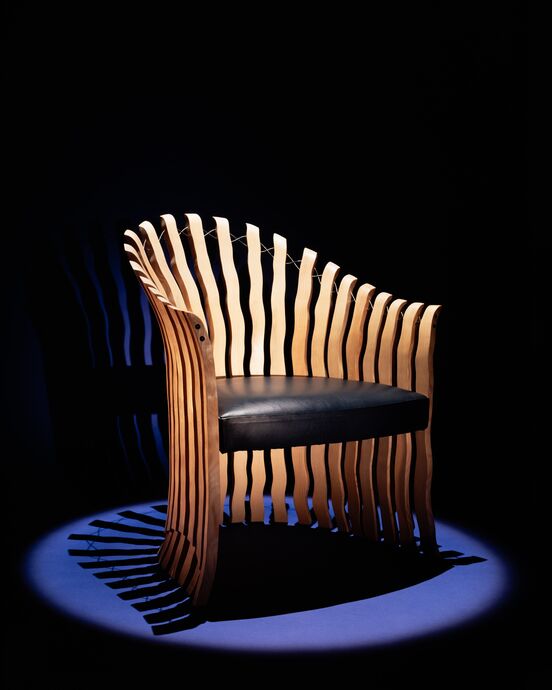
He Nehenehe, 1993
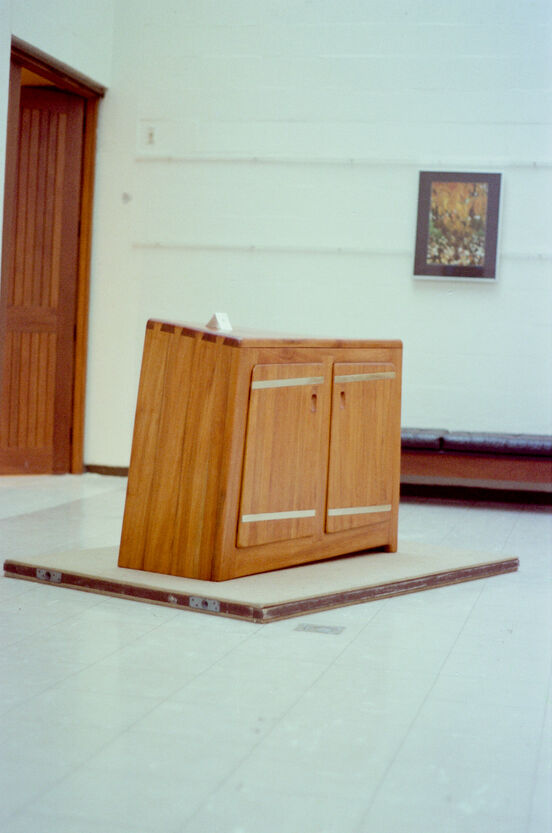
Go For Credit In The Straight World, at CSA Gallery, 1981
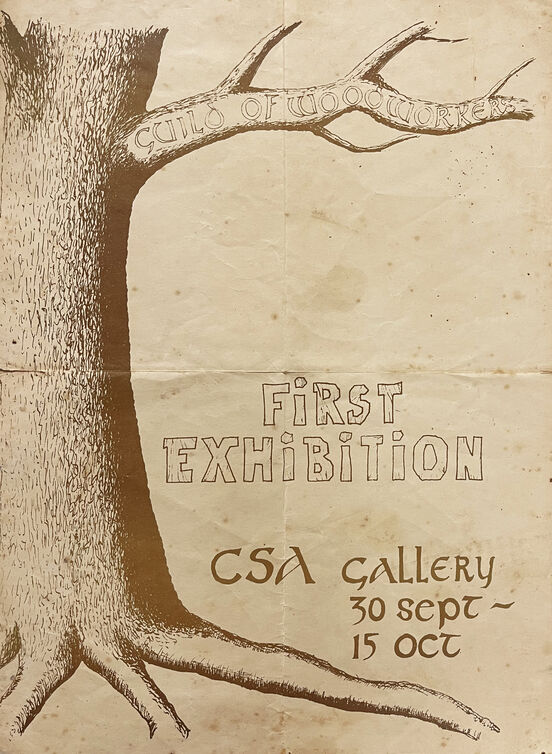
Poster for the Guild of Woodworkers First Exhibition, CSA Gallery, 1977
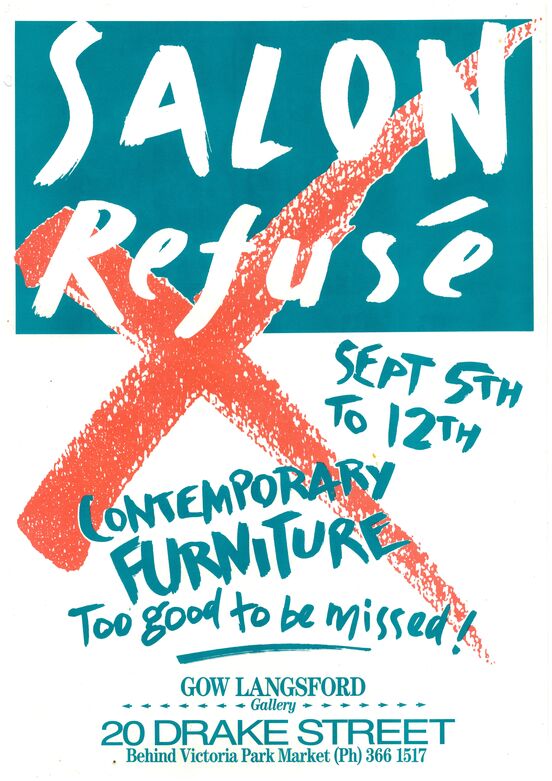
Poster for Salon de Refuse exhibition, 1988
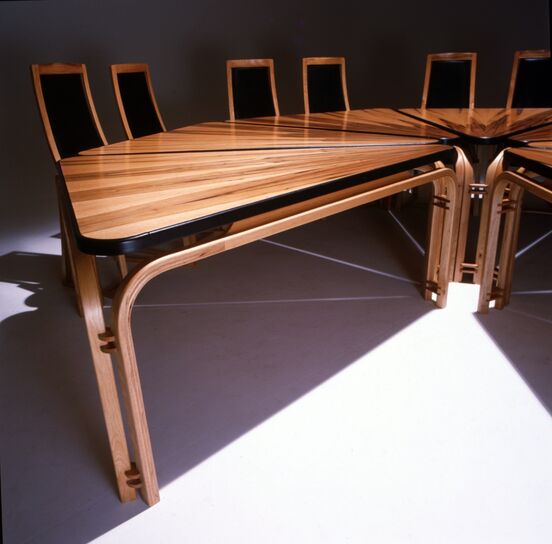
Ngā Manunu o Te Puia, 1985
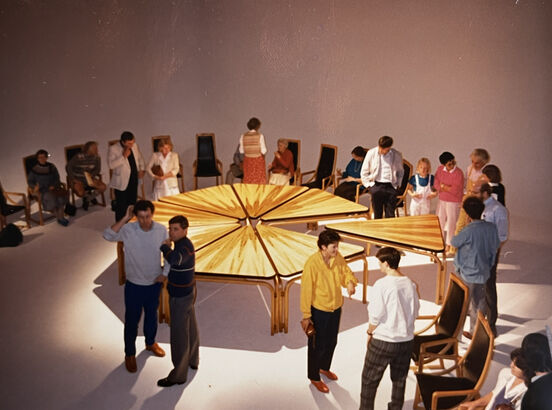
Celebration for the completion of Ngā Manunu of Te Puia, Glenfield, 12 October, 1985
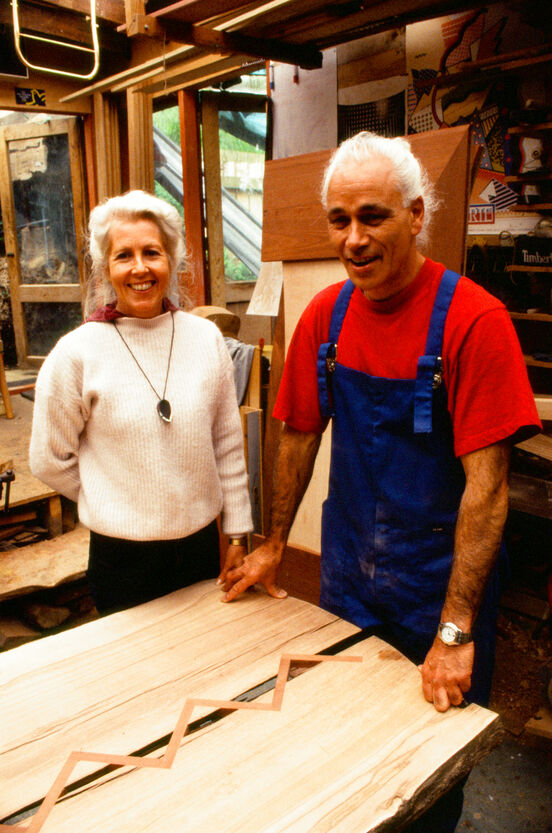
Carin Wilson and wife Jenney, with the original Te Whakaoranga, 1994. The table was remade in 2026.