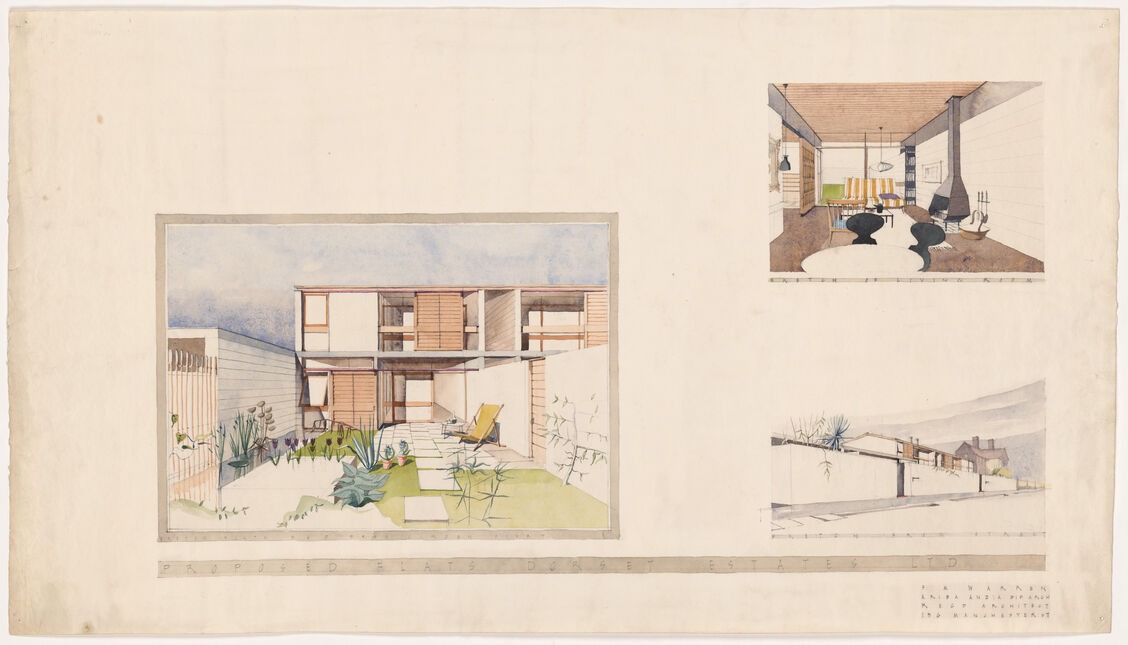
Sir Miles Warren was a watercolour painter all his life. Drawing was integral to his professional career – he was New Zealand’s most prominent mid-twentieth century architect – and was also a personal passion.
The enchantment started early. Although art barely figured in his 1940s Christ’s College education, young Warren painted ‘little watercolours’ during the school holidays. His training in the medium began in Christchurch architecture studios, especially that of Cecil Wood (1878–1947), a superb illustrator who used watercolour paintings as tools of client persuasion. ‘Pretty pretties’ was how Wood characterised these drawings; Warren would later apply the same self-deprecating term to his own watercolours.
In the evenings, Warren honed his drawing skills at the Christchurch ‘Atelier’, where student architects prepared painstaking watercolour renderings of famous buildings of Greek and Roman antiquity. These ‘testimonies of study’, he wrote, constituted ‘the last flicker’ of the Classically-focused art and architecture curriculum prescribed since the mid-nineteenth century by the influential École des Beaux-Arts in Paris. At Auckland University College’s School of Architecture, which Warren attended in 1949–50, drawing competence was also expected. For Warren, drawing was not merely a course requirement; it was a pleasure. Out of class, he made very painterly watercolours of Auckland’s cityscape and waterfront.
Warren continued to paint during his ‘OE’ in London in the early 1950s. Over the following four decades, as he and Maurice Mahoney built and led the successful architectural firm of Warren and Mahoney, his drawing was directed to professional ends (Warren and Mahoney then favoured the sketch over the model as a means of architectural representation.) But Warren still found time to paint non-work subjects, and when, after his retirement in 1994, he heard that John Coley, a former director of Christchurch’s Robert McDougall Art Gallery, planned to go to Europe with his wife Fay and ‘paint the ruins’, he invited himself along. For a dozen years Warren accompanied the Coleys on annual European painting excursions, delighting in this self-conscious revival of the eighteenth century aristocratic watercolourist’s Grand Tour, and gracefully expressing on his sketch pad his formidable understanding of building form and profound appreciation of architectural detail.
—
Sir Miles Warren (b. Christchurch 1929; d. Christchurch 2022) was one of Aotearoa New Zealand’s leading mid-twentieth century Modernist architects, and a prominent figure in his field for half a century. Educated at Christ’s College and Auckland University College’s School of Architecture, he worked in Christchurch architecture firms and the architecture department of London County Council before going into partnership with Maurice Mahoney (1929–2018) in 1958. Christchurch-based Warren and Mahoney’s notable buildings include College House (University of Canterbury, 1964), Christchurch Town Hall (1972) and the New Zealand Chancery in Washington D.C. (1981). With his sister Pauline and brother-in-law John Trengrove, Warren created the celebrated garden at Ōhinetahi, Governor’s Bay. He was knighted in 1985 and appointed to the New Zealand Order of Merit in 1995.
John Walsh is a former editor of Architecture New Zealand and the author of a dozen books on New Zealand architects and architecture. He edited the publications accompanying New Zealand’s exhibition at the 2014 and 2016 Venice Architecture Biennale and recently has written guides to the architecture of Dunedin (2026), Wellington (2025), Christchurch (2023) and Auckland (2021), all published by Massey University Press. He has contributed to numerous magazines and periodicals, and in 2023 curated an earlier exhibition of Miles Warren watercolours, staged by Objectspace at the Miles Warren Gallery in Christchurch.
—
Drawing practice: Miles Warren watercolours 1949–2007 is presented by The Warren Trust.

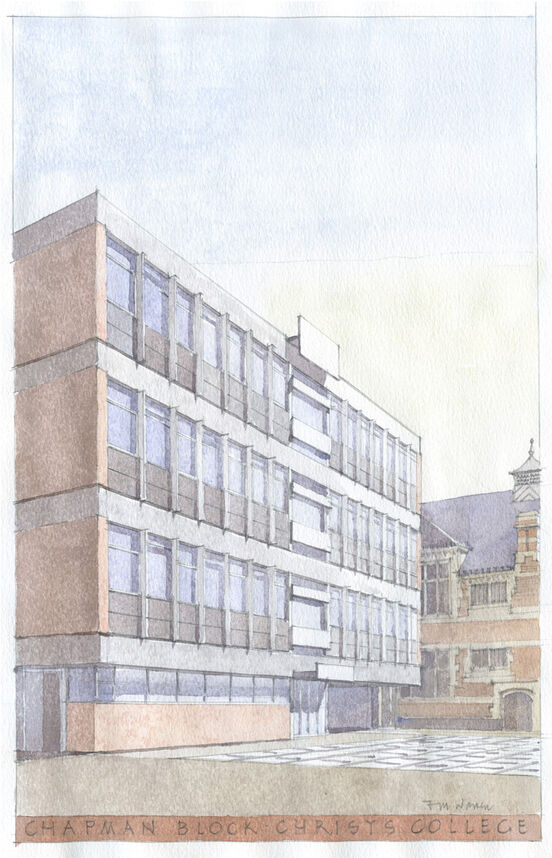
Miles Warren, Chapman Block Christ’s College [built 1960]
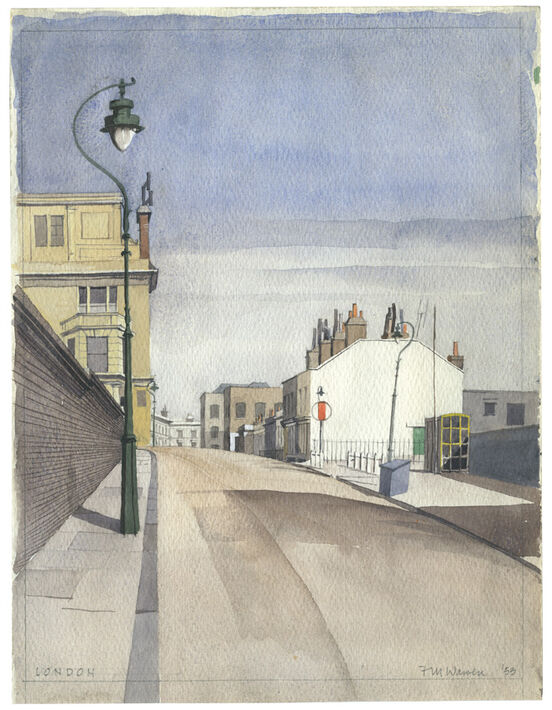
Miles Warren, London, 1953
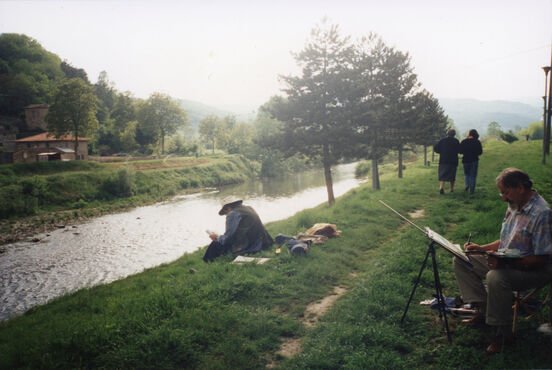
Miles Warren and John Coley painting en plein air on their travels, photo courtesy of Fay Coley