-
Author
Zoe Black, Carin Wilson and Arielle Walker -
Date
8 Jul 2026
Essay
Carin Wilson from Artiture to Ngati Awa’s Treaty of Waitangi claim – late 80s to early 90s
Writing on works by Carin Wilson to accompanying the exhibition He maramara tupu aranga
Artiture was facilitated by a core group of designers including Marilyn Sainty, Carin Wilson, Biz Dempster, Peter Rogers and Diana Firth. It continued for seven iterations, touring to different venues each year, including internationally to Japan. A landmark moment in Aotearoa furniture design, Artiture is remembered as a foundation for how contemporary design is understood in New Zealand. Nanette Cameron covered the first Artiture exhibition for New Zealand Crafts magazine (Autumn, 1987), giving the following review:
Recently in Auckland the bare top floor of a dilapidated old Queen Street building, rented at low cost, was transformed into a calico draped cavern to display a collection of innovative furniture designed by a group of alternative designers. They all wanted to design furniture that was art, not constricted by the necessity of the pieces having to be a commercial proposition. They wanted to create furniture imbued with a more human quality.
Following the success of Artiture and other furniture exhibitions in the 1980s, The New Zealand Contemporary Furniture Exhibition was held at Auckland Museum in 1988. It invited designers and furniture makers to submit pieces for selection by international judge, George R Ingham, from Canberra School of Art. Controversially, from the 75 exhibition entries only 24 were selected for the exhibition. Justine Olsen, curator at Auckland Museum at the time, described: ‘The selection resulted in the rejection of some works by leaders in the field. George Ingham applied his criteria to all works with no knowledge of the artists involved.’
In haste, the rejected pieces were gathered and presented in a salon des refuses style exhibition elsewhere in the city. This too was contentious, as it was rumoured that new works were added and some rejected pieces showed evidence of alteration.
In a subsequent issue of New Zealand Crafts magazine, Olsen, Colin Slade and Carin Wilson offered accounts and opinions on the events. Slade commenting: ‘on the one hand is the art world which refuses to admit the craft of furniture as a discipline worthy of respect, and on the other hand is the industry with too few examples of fine art furniture to be inspired by.’
In 1989, Wilson hosted an episode of the television show Kaleidoscope and presented a feature called ‘The New Furniture’ that offered an overview of these exhibitions and furniture design of the time. 1988 came to be known as a watershed year for New Zealand furniture with more furniture exhibitions and more furniture makers participating than any time in the movement’s short history.
—
Royal Pain in the Arse was, in the words of design legend Nanette Cameron, the ‘tour de force’ of the First Annual Artiture exhibition in 1987 – a ‘brilliant piece’ that has become a key moment in Wilson’s Artiture oeuvre. The sweeping curves of the chair follow a familiar form in Wilson’s practice, reflecting the one-off Nohotū chair editions he developed across the late 80s from his QEII Arts Council commission. Where Wilson finessed Nohotū towards comfort, Royal Pain in the Arse is intentionally discomforting.
Furniture form or satirical sculpture? Made from tawa, oak, and blackwood, the seat of the chair is comprised of jagged, broken pieces of timber, jutting sharply upwards; the laminated ply back has been shattered and carefully re-formed around a pattern of torn holes.
The chair is objectively unusable: to sit here would be excruciating. With his pointed humour carrying through in both form and name, Royal Pain in the Arse is Wilson’s most tongue-in-cheek commentary on the Crown – a subject at the heart of much of his later work.
Picking up this thread decades later, Wilson made a 2024 sequel work, Kikokiko Throne, as a direct response to the government’s proposed Principles of the Treaty of Waitangi Bill. From the protective packing used to transport Nohutū for inclusion in the Objectspace exhibition The Chair, Wilson shaped a ‘ghost chair’, an intentionally flimsy counterpart to Royal Pain’s barbed presence. On behalf of Studio Pasifika, Wilson offered up this new Throne as an award to a politician with “fawning royalist pretensions,” for “development of farcical concepts” and “propositions of little or no substance by kehua entities.”
Playing with the line between furniture and sculpture, at once both and neither, Royal Pain in the Arse embodies Wilson’s design ingenuity, but even more so, his unique gift for storytelling through object.
– Arielle Walker
—
Wilson’s retrospective He maramara tupu aranga brings together works from across his career that speak to his Māoritanga and an articulation of his culture through making. The table Te Whakaoranga marks the starting point of this investigation in his practice, the motivation detailed by Wilson below.
During the years 1993 to 1995 I was on the committee guiding the compilation of massive volumes of evidence that would become Ngati Awa’s Treaty of Waitangi claim. The emotional impact on our people had already been conveyed to me as a child when I sat with my grandmother Anahera and some of her kuia hearing their tangi about loss. I didn’t really understand it at that time but had no difficulty measuring the effect.
A series of hui were held on marae in our rohe where we met the tribunal. I was so impressed with the dignity and composure of our kaumatua and started visualising things I could make based around the moteatea we sang.
Te Whakaoranga was created as a considered meditation on how to redirect my reactive energy. The imagery of the stitch healing that rift in the beautiful maire tabletop arrived in a dream and determined every move that followed.
I had sourced the tree from ngahere that had been cleared to make way for a pinus plantation – a stupid act of corporate vandalism the merchants of exploitation will condone in the name of progress when they can get away with it.
They had planned to bulldoze these taonga and let them decay, a breathtaking insult to Indigenous mana. Protest was futile, but we retrieved what we could afford by engaging a miller. I resolved the anguish by forcing a metaphorical coalition of unity in the base, coaxing native and colonial timbers to co-operate in the conjugation of a truss.
—
A carved sign was made from the same maire tree as Te Whakaoranga. This whakatauki is a critical sentiment to Wilson’s practice and has hung outside his studio for many years. A proclaimation to hold fast to our culture, for without language, without mana, and without land, the essence of being Māori would no longer exist.
—
Texts written to accompany He maramara tupu aranga: Carin Wilson and 50 years of Aotearoa design, 27 Jun–30 Aug 2026 at Objectspace in Tāmaki Makaurau Auckland and 26 Sep–1 Nov 2026 at Objectspace at Sir Miles Warren Gallery in Ōtautahi Christchurch.
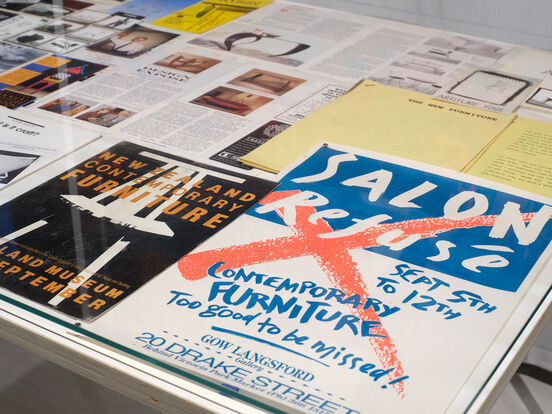
Carin Wilson’s ephemera collection from furniture exhibitions, 1980s and 1990s, photograph by Sam Hartnett
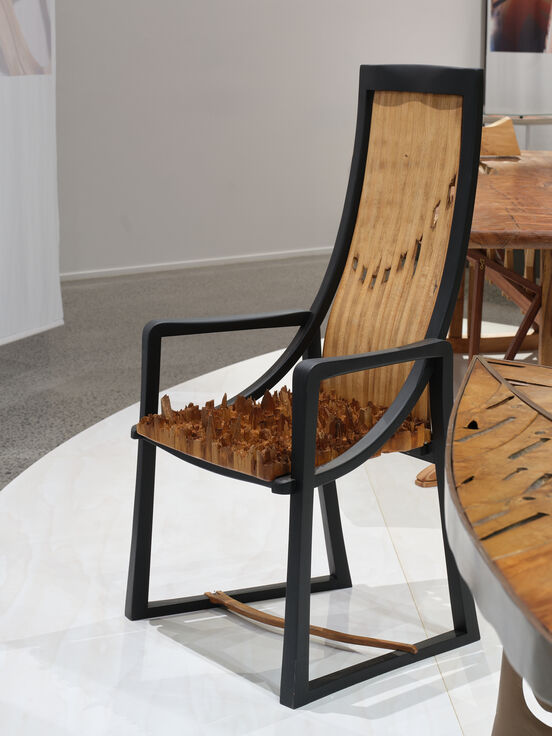
Carin Wilson, Royal Pain in the Arse, 1987, tawa, oak, blackwood, photograph by Sam Hartnett
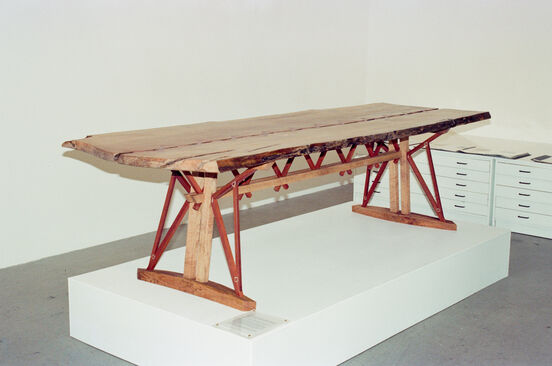
Carin Wilson, Te Whakaoranga, 1994, maire, oak, jarrah, waxed linen thread
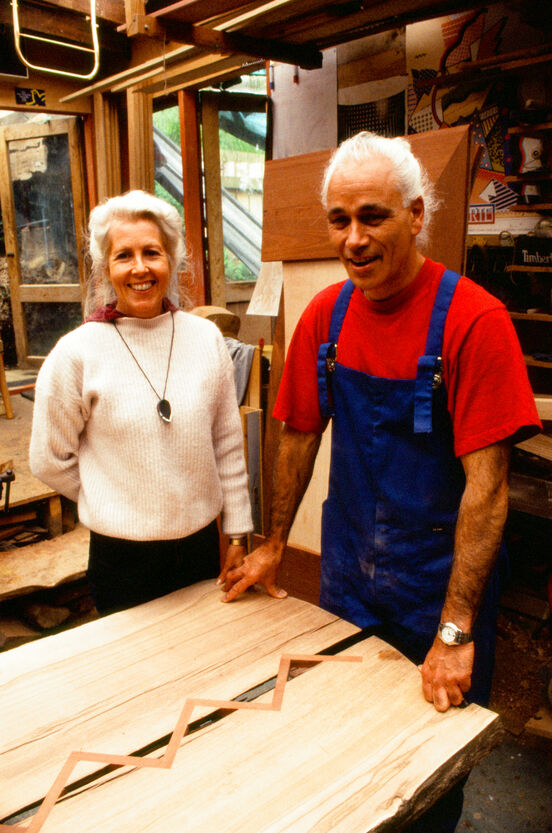
Carin Wilson and wife Jenney, with the original Te Whakaoranga, 1994. The table was remade in 2026.
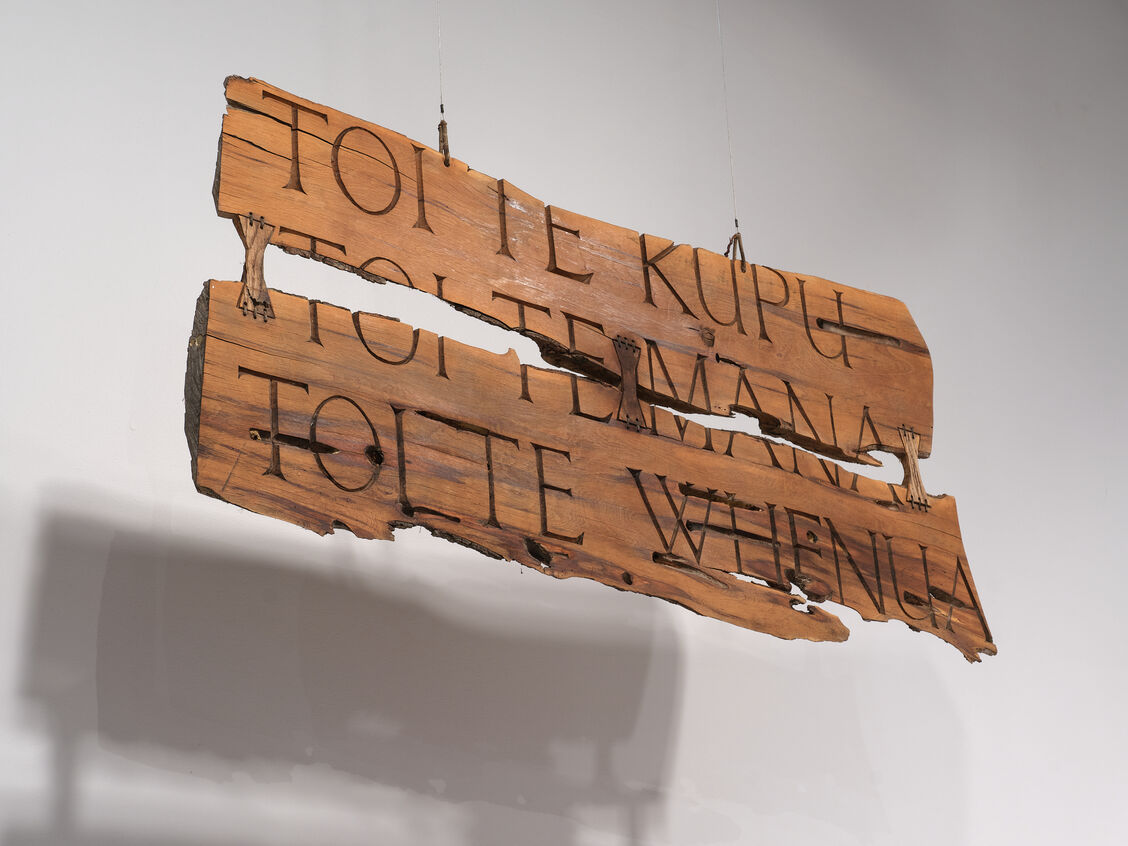
Carin Wilson, Toi te Kupu, Toi te Mana, Toi te Whenua, c. 1983, maire, steel, photograph by Sam Hartnett