-
Author
Salene Schloffel-Armstrong -
Date
5 Nov 2026
Essay
The undisciplined autonomy of the coast
I've always been enamored of writing that ties a city's identity to a particular type of weather or landscape feature – Joan Didion's famous 1968 essay on the Santa Ana winds in Los Angeles being a key one – despite the echoes of environmental determinism. And I still desire to draw these lines of correlation in Tāmaki Makaurau Auckland too.
The city has grown following the constraints of the coasts of this skinny isthmus and its two harbours (one of the few cities in the world to have harbours in two different major bodies of water). I believe the specificity of this coastal landscape must impact the feeling of this city in indelible ways, beyond the obvious stickiness of its humid subtropical climate. But, I am not a climatologist, so I'll draw on Janet Frame for evidence instead. She wrote in her novel Living in the Maniototo that the seasons in Auckland are haphazard, and so:
spring is personal – your peach tree and mine do not blossom at the same time; our freesias and daffodils live in different seasons. This undisciplined autonomy of vegetation is reflected in the uncontrolled growth of the city and the suburbs, and is shown in the people as a freedom of mood and impulse.1
The freewheeling, vigorous freedom of growth of this city, in its built form, its vegetation, and its people, relate to both its climate and its form. The climate, the sea breezes, the micro seasons by suburb – I see these specifics as a direct co-relation of our ‘coastiness’.
At the point of amalgamation of Auckland as a supercity in 2010, 3,700 kilometers of coastline officially came within the city's territorial bounds. And yet, while the presence of the coast suggests an edge, in reality, it troubles the fixed nature of that idea too.
I remember a physical geographer I once shared an office with explaining his difficulty in where to assign the ‘edge’ of Aotearoa in a mapping project of the coastline: did the land end with sand that was always dry, sometimes dry, or the sand that was always wet?
Instead of a hard boundary, they are spaces of negotiation, central to the history of this land: places of both encounter and contestation.
Coastlines are also areas of visible more-than-human presence – salt spray, waves, sand, sea breezes – often causing the degradation of built forms near these edges. The built heritage on our coasts is full of forgotten uses, and the shore's impact on our built environment is often neglected.
But we have shifted these spaces ourselves also, through – usually colonial – processes of land reclamation, as at Mechanics Bay where now a police car park sits at the base of The Strand, on the site of a major trading hub where waka were pulled up to rest on the shore.
Today, the threat of storm surge and sea level rise is leading to complicated reorientations in our country's political economy. Once the most expensive real estate, it appears the un-insurability of seaside villas and clifftop mansions in Tāmaki might be beginning to trouble both their value and prestige.
These negotiations of edges might be useful to orient us to more flexible kinds of futures; make us more open to negotiations we cannot control. And yet, Aucklanders continue to orient ourselves, and our identities, through these relationships to the edge of the sea.
As generously explained to me once on a date – at the appropriately pirate themed Swashbucklers Restaurant & Bar – people from the Hibiscus Coast imagine themselves as from somewhere very distinct. As a location for a lesson in Auckland suburb identity politics, the staunch holdout of Swashbucklers is the perfect place: an old school maritime themed tavern in the belly of the super yacht marina. When I made the mistake of drawing parallels between the Northern suburbs stretching from the Harbour Bridge (the North Shore), and those spreading along the Whangaparāoa Peninsula (The Hibiscus Coast), I was quickly corrected. As an outsider (although my father recently relocated to Stanmore Bay), the apparent similarities of suburban, coastal living tricked me! But, as I quickly learnt: ‘Coasties’ are not from ‘The Shore’!
I believe these differences and distinct identity markers are important. But also, it may only be in this fine city that two suburban monikers we cling to (and defend) would both describe people in their relation to the edge of the sea.
—
Salene Schloffel-Armstrong is a geographer who is interested in public services and collective resources. She is currently a postdoctoral researcher at both Waipapa Taumata Rau The University of Auckland and Te Whare Wānaka o Aoraki Lincoln University. When she isn't at the beach or watching the Warriors she likes to spend her time walking around cities and writing about them.
—
1 Janet Frame, Living in the Maniototo. Hutchinson, 1981.
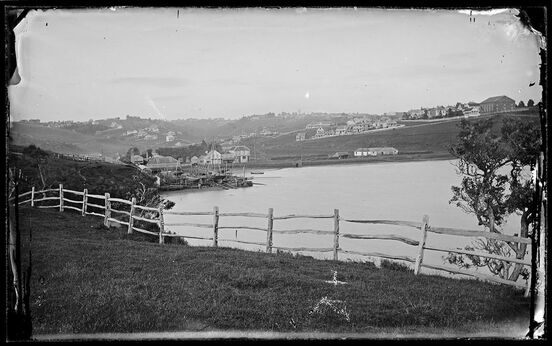
Mechanics Bay, Auckland, 1983, photo by Daniel Manders Beere, Alexander Turnbull Library 1/2-096112-G
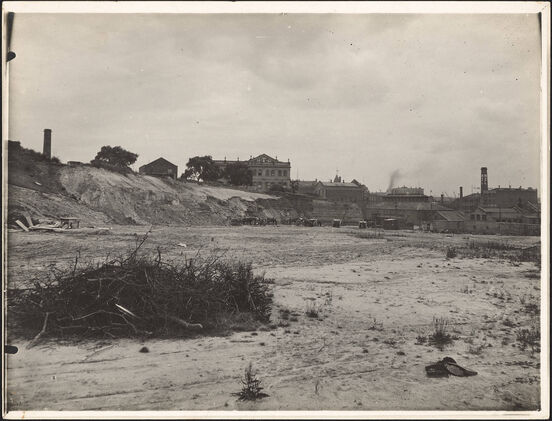
Demolition of Britomart Point: ‘looking south across the reclamations at Britomart towards buildings on Customs Street East’, c. 1880–89, unknown photographer, Auckland Libraries Heritage Collections 1043-120
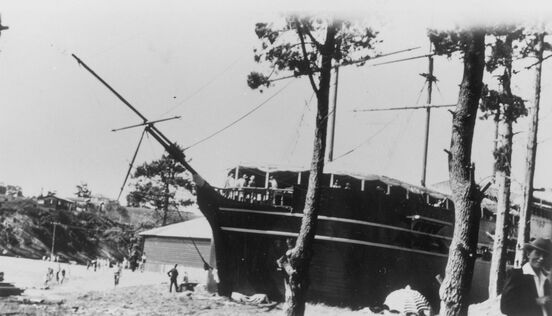
Pirate Shippe, Milford Beach Reserve, Milford, Takapuna, 1927, unknown photographer, Auckland Libraries Heritage Collections T2458
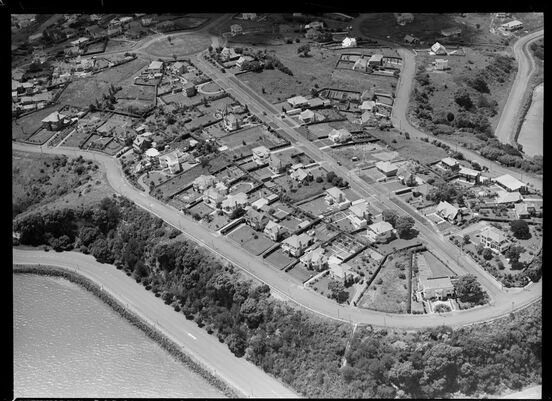
Paratai Drive, Orakei, Auckland, 1948, photo by Whites Aviation, Alexander Turnbull Library WA-18024-F
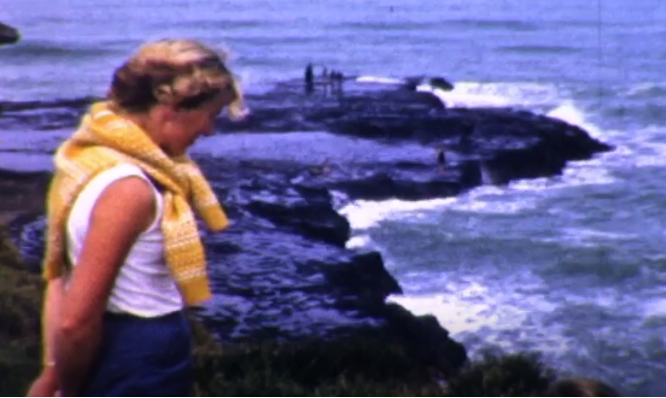
Still from Super 8 film of Salene's Oma Nellie on the west coast of Tāmaki in the mid 1960s, writer’s own.