-
Author
Oscar Mardell -
Date
22 Oct 2026
Essay
Ōrātia: Neitherland
The term ‘Edgeland’ – denoting a buffer zone between the city and the countryside, an intermediary landscape between the urban and the rural – was coined by the British geographer Marion Shoard in her 2002 essay ‘Edgelands of Promise’. ‘Often vast in area, though hardly noticed,’ this zone, explained Shoard:
is characterised by rubbish tips and warehouses, superstores and derelict industrial plant, office parks and gypsy encampments, golf courses, allotments and fragmented, frequently scruffy, farmland.¹
Today, it’d be impossible to call this landscape ‘hardly noticed’. In Britain, at least, the Edgeland has been so thoroughly picked-over – has been the subject of so many think-pieces, photo-journals, video-essays, walking-tours, guidebooks, and Reddit threads – that it now constitutes a fixed aesthetic. It has become instantly recognisable and easily reproducible: the ruin-porn of Romanticism overlaid onto the interstitial and ‘liminal’ spaces of Situationism and Psychogeography. Its promise, then, appears to have been largely exhausted; its wilderness, over-defined.
Why didn’t the vogue for Edgelands spread to Aotearoa? On the one hand, our cities, it probably goes without saying, tend to lack the density of Britain’s. On the other, our rural areas rarely qualify as countryside as such – i.e. they aren’t bucolic enclaves where people and nature co-exist in harmony, altogether exterior to the forces that determine city life (of course, Britain’s own countryside – its real, rather than its mythic, countryside – would never qualify by this definition either); instead, they’re swathes of industrial agriculture interspersed with occasional pockets of protected reserve – landscapes of extraction punctuated by oases of exclusion. Rather than any real buffer zone, rather than some vast intermediary between the urban and the rural, the edge in Aotearoa is often absolute – a sharp and total divide at which sprawling suburbia sits flush against fertile farmland, where residential outgrowths intrude directly upon (and, increasingly, threaten to overtake) crops and livestock.
Ōrātia, on the western edge of Tāmaki Makaurau, is, perhaps, an exception. To its east is Waikumete Glen Eden (whose new-builds have now overtaken what, on my previous visit, was the site of Nolan’s Orchard), and to its west are the Waitākere Ranges (where further intrusions are prevented by both the Waitākere Ranges Heritage Area Act 2008 and the Auckland Unitary Plan). Hence, Ōrātia appears to offer what local real estate agents routinely call the ‘best of both worlds’ – proximity to (sub)urban convenience and to a protected reserve – whilst truly belonging to neither. Unlike Titirangi, however, which sits further within the Waitākere Ranges, Ōrātia is still no place for metropolites to play at going bush.
Preserved in the foyer of the Settlers Hall on West Coast Road is an 1940s graffito satirising (and, indeed, drawn by) members of the Jugoslav Orchestra – a folk and jazz band formed by the Dalmatian migrants who ran and manned the nearby orchards. Around the back of Just Plane Interesting on Parrs Cross Road, a converted stable contains a group of mannequins which I have seen enacting, variously, methods of capital punishment, scenes from 'Xena: Warrior Princess' (much of which was filmed in nearby Ōpanuku Henderson), and a sort of neon-soaked, fairy fantasia. Last year, a 1.4ha section on West Coast Road was sold to a particular buyer on account of the fact that he possessed good ‘aura’. And for three hours on the second Sunday of every month, a koha (donation) will grant you entry to the charming volunteer-run Folk Museum – a mouldy, 1870’s cottage transplanted from up the road (after the local fire department requested to burn it down for their training), then filled with a haphazard assortment of old stuff – little of it from the nearby area or accompanied by any real interpretation. Ōrātia, then, appears to retain a degree of informality or resistance to ‘masterplanning’.
Still, I am reluctant to categorise Ōrātia as an Edgeland, if only for fear of imposing yet another of what the art historian Francis Pound called ‘Frames on the Land’: prefabricated, foreign-imported schema through which to (mis)read the local environs. Is some more locally-specific schema available? One that might, moreover, transcend the Romantic/Psychogeographic/Situationist clichés? In a 2018 piece for the Pantograph Punch series ‘Loose Canons’, i.e. Crazy (a.k.a. Frances Libeau) explained:
I think of the New Zealand Gothic as a kind of inverse/negative psycho-geography; less romantic sublime and more quiet terror; less Situationist ramble, more provincial disorder. The banal is charged with quiet terror, the surface cracking with repressed traumas that return, zombie-like, through generations.²
Historically, Ōrātia’s claim to fame lay in its role as Tāmaki Makaurau’s fruit bowl: from the 1860s onwards, the area was planted with orchards (of which, the sole survivor appears to be Dragicevich & Sons). Around the back of the Folk Museum, a display commemorates the ‘simple life’ led by the families who owned and worked those orchards (a display which appears, incidentally, to have been erected in response to Watercare’s 2017 plans to construct a treatment plant – plans which were eventually abandoned on account of the resistance put up by the Ōrātia community). But what ‘quiet terror’ charges this banality? What ‘repressed traumas’ crack this pastoral ‘surface’?
Some members of my family recently looked into purchasing a plot of land situated on one of Ōrātia’s former orchards. After more than a century of being sprayed with pesticides and fungicides, the site, it turned out, was so heavily contaminated – so full of lead arsenate, copper, and DDT – that in order to live there, they would have needed to raise the soil level by several metres. If a certain wilderness or disorder has been able to prevail out here, if the city and its values have had difficulty encroaching further west than Nolan’s Orchard, this is, at least in part, because the land itself has been poisoned.
—
Oscar Mardell is a writer and educator based in Tāmaki Makaurau Auckland. He is the author of Delirious New Lynn; or, Portage and Euphoria; or, The Carryover – a wildly eccentric 'guidebook' which promoter, DJ and musician Matthew Crawley once called 'a demented masterpiece'.
—
¹ Marion Shoard, ‘Edgelands.’ Remaking the Landscape, edited by Jennifer Jenkins, Profile Books, 2002.
² Frances Libeau, “Loose Canons: Frances Libeau,” The Pantograph Punch, 19 Oct. 2018, www.pantograph-punch.com/posts/loose-canons-frances-libeau.
—
This text was commissioned to accompany In the image of the city, 11 Sep–15 Nov 2026 at Objectspace in Tāmaki Makaurau Auckland.

Just Plane Interesting on Parrs Cross Road, photo by Oscar Mardell, 2026.
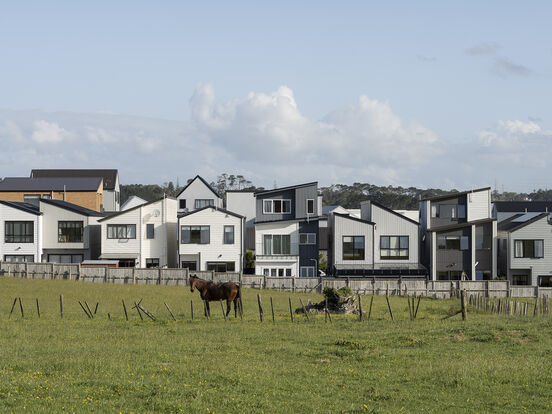
Rather than any real buffer, the 'edge' in Aotearoa is often absolute – here new housing sits flush with farmland in Westgate, photo by David Straight, 2026.
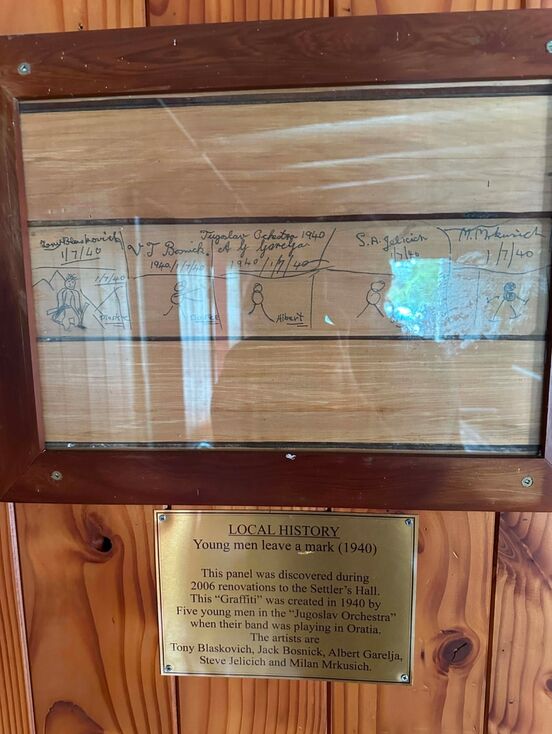
1940s graffito satirising (and, indeed, drawn by) members of the Jugoslav Orchestra, Settlers Hall, photo by Oscar Mardell, 2026.
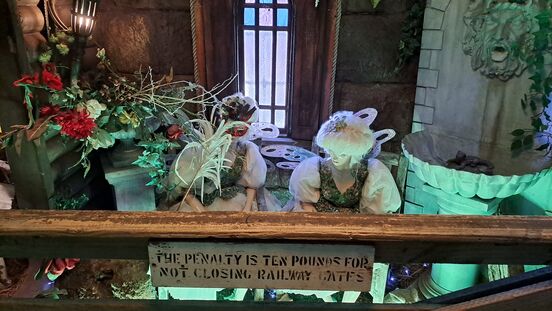
Neon-soaked, fairy fantasia tableaux at Just Plane Interesting, photo by Oscar Mardell, 2026.
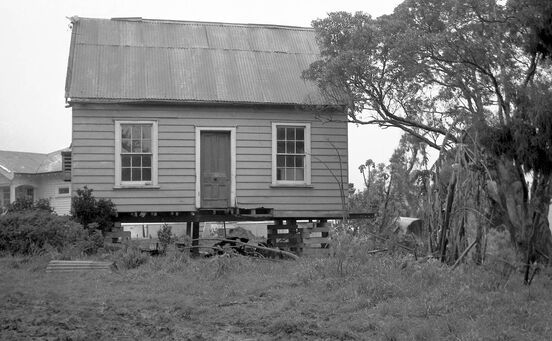
What is now the Ōratiā Folk Museum on temporary foundations, photo by J.T. Diamond, c. 1960–69, Auckland Libraries Heritage Collections JTD-13A-03987-1.
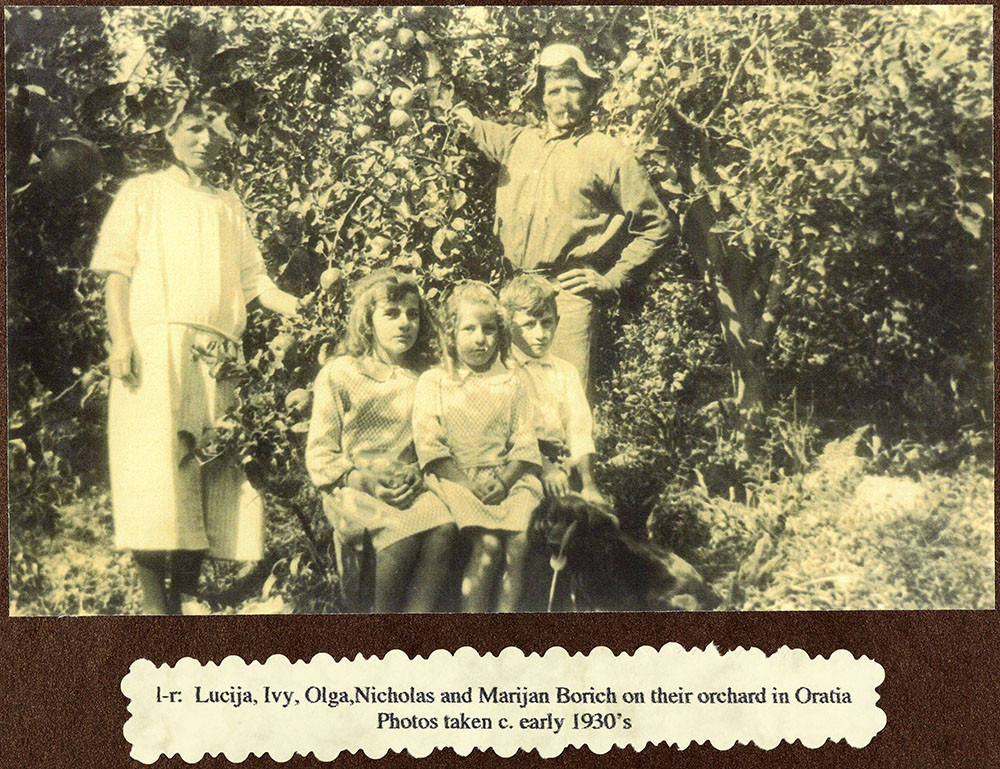
View of the Borich family in their Ōratiā orchard in the 1930s, unknown photographer, Auckland Libraries Heritage Collections DGHS-PA-1-1-009.