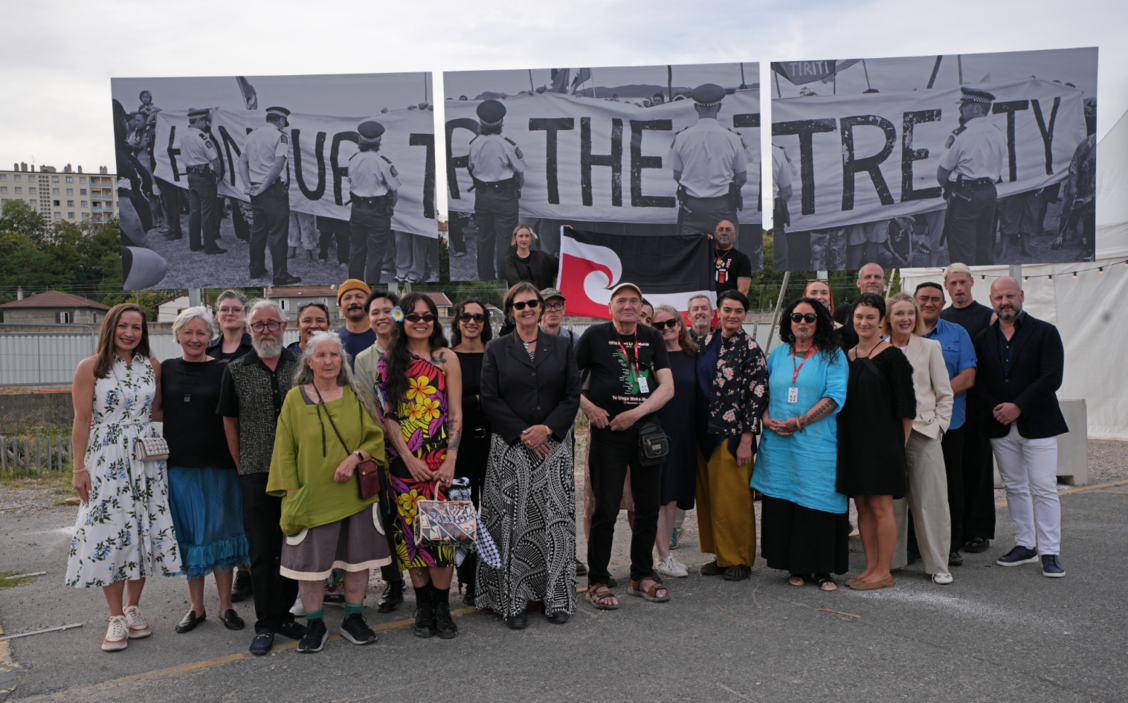
Fresh from recent travel to present work at the 18th Lyon Biennale of Contemporary Art in France, join John Miller as he shares a glimpse at his journey and reflections on sharing his work on the international stage.
The 18th Lyon Biennale of Contemporary Art, in France featured a number of artists from Aotearoa:
Fiona Clark, Ngahina Hohaia (Taranaki Iwi, Te Atiawa, Ngāti Ruanui, Ngāti Mutunga, Parihaka), Rangi Kipa (Te Āti Awa,Taranaki, Ngāti Mutunga, Ngāti Tama), Maureen Lander (Ngāpuhi, Te Hikutū), Yana Nafysa Dombrowsky M’Baye, John Miller (Ngāpuhi, Ngāi Tawake ki te Tuawhenua, Te Uritaniwha, Ngāti Rēhia, Te Whiu), Sriwhana Spong, Michael Stevenson, Ashleigh Taupaki (Ngāti Hako, Ngāti Rangitihi, Ngāti Kahungunu) and Luke Willis Thompson
John Miller presented two bodies of work as part of the biennale:
Two public events, separated by almost forty years, record the continuing struggle over Māori land and sovereignty in Aotearoa New Zealand. John Miller’s first series documents the Māori Land March of 1975, when thousands traversed the length of the North Island to protest continuing land loss and demand that Te Tiriti o Waitangi (the Treaty of Waitangi) be honoured. Signed in 1840 by many Māori chiefs and representatives of the British Crown, the Treaty affirms Māori sovereign rights and authority over their lands and resources, yet repeated breaches by the Crown have kept it at the centre of political struggle. His second series records commemorations marking the 150th anniversary of the Battle of Rangiriri fought in 1863 during the New Zealand Land Wars. The defeat of the Waikato tribal forces at Rangiriri by the British Army opened up the rich and productive Waikato lands to large-scale seizure and confiscation. The accompanying slide show offers insight into the ongoing nature of these struggles and the broader scope of Miller’s documentary practice.
Britain proclaimed sovereignty over Aotearoa New Zealand in 1840 and established it as a separate Crown colony the following year. Māori resistance to land seizure and the erosion of their authority over their lands has continued ever since. Photographed on Waitangi Day, 6 February 2001, John Miller’s triptych shows demonstrators holding a banner reading HONOUR THE TREATY as police stand opposite them. Waitangi Day commemorates the signing of Te Tiriti o Waitangi (the Treaty of Waitangi) in 1840 by Māori chiefs and representatives of the British Crown. Across three frames, enlarged in Lyon to billboard scale, HONOUR THE TREATY is broken into separate words. The demand, repeated by Māori year after year, calls on the Crown to honour its commitments under the Treaty and address the continuing dispossession and violence produced by its failure to uphold them.
John's presentations at the Lyon Biennale are made possible through the support of Waipareira Trust, the New Zealand Cultural Diplomacy International Programme, Season Aotearoa, Motion Sickness, Charlotte and Christopher Swasbrook, Hamish Coney and Creative New Zealand. He is represented in Aotearoa New Zealand by Season Aotearoa.
The participation of the artists from Aotearoa in the Lyon Biennale was facilitated by the Office of Contemporary Art Aotearoa.
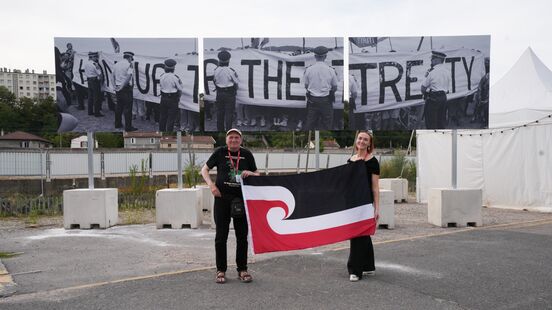
John Miller and daughter Rereata Miller in front of John's triptych at Lyon, photograph by Clare Jane
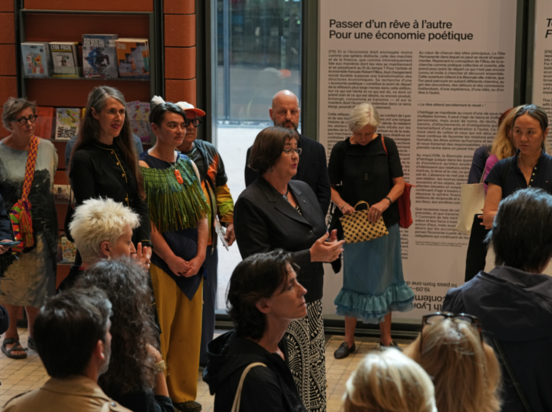
Pōwhiri for the New Zealand Ambassador to France, Joanna Kempers, at MACLyon, photograph by John Miller
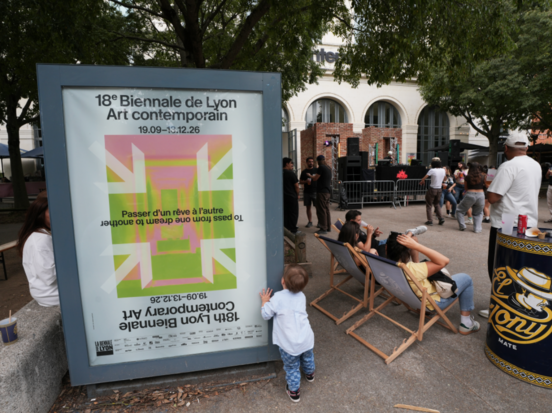
MACLyon exterior, photograph by John Miller