-
Author
Finn McCahon-Jones -
Date
11 Feb 2026
Essay
Mineral Supplements
Library of rocks
Walking into Warwick Freeman’s workshop, the walls are lined with floating shelves at about shoulder height displaying large natural curiosities whose sculptural presence looms thick in the room. There are pieces of driftwood artfully eaten by worms; sticks so perfectly curved they look like they had been formed in a mould; clusters of rocks carefully arranged in sculptural taxonomies (smooth, sharp, ones with holes, face rocks, round rocks, lava bombs); pieces of turtle shell; a branch of coral; shells; something that looks like beach-tumbled-polystyrene, and wind-shaped ventifacts.
Each of these found objects is archetypal in its form. As a collector of found objects myself, I am in awe as I look around the room. The array of materials speaks not only of the time required to find these, but also of geography traversed and the finely tuned eye of a collector.
Under these shelves and workbenches are myriad cabinets crammed with potential – drawers and containers piled with rocks, shells and tree branches that have had various alterations and cuts. Small things, lapis lazuli, carnelian and jasper spheres. Scoria cores – each sliced perfectly like fancy crackers. Rock stars, rock hearts, teeth, bones, shells, wood. All in various stages of completeness, or completely abandoned. The collections in Freeman’s workshop act as his “library”.
Scattered on the bench in front of us is an array of Coromandel carnelian. Freeman wets his finger and starts rubbing a piece of carnelian to reveal the ancient interior. “I’m always cutting, looking and storing the potential,”1 he tells me as he contemplates the stone. We browse his workshop, pulling open drawers to look at the rocks and picking up the ones that catch our eyes.
Surrounded by his library, it is clear that some are materials, but others are definitely objects in their own right, expressions of nature, rocks too good to cut. Although Freeman applies himself to the materials there is a kind of literalism at play. He is representing the material as much as the idea. A kind of truth, not to, but of materials. He is expressing and celebrating the subtleties and quirks of the material in the guise of jewellery. Freeman works with the found object in such a way that you are in possession of a special find from his rock collection as much as you have a piece of jewellery.
“The material is always sending the message. Yes / no, you can or can’t do this”.2
Freeman is referring here to whether the material can hold the idea, either physically or conceptually, but ultimately within the form and function of jewellery. As we’re looking and talking, he picks up a curious black stone, partly addressing me and partly addressing the questions: how strong is it? What happens if I accidentally drop it? He explains that all his material relationships start by dropping it on the floor. “This is the first test. If it can survive being dropped, you have potential.” I watch the stone bounce across the studio floor. Picking it up, he adds, “Then you keep working with the material until it reveals its limits.” 3
What’s the Matter
Freeman twists the black nugget between his fingertips and tells me the story of jet. Classed as a soft gem made from compressed carbon, it was used as fuel on ships at the turn of last century. The piece in his hand, he tells me, found on the shore of the Bay near his home, was probably washed overboard in colonial times and has been bobbing around on the shore since. And of course, this material was also very popular in mourning jewellery during the reign of Queen Victoria.
From this short conversation I have been pulled into the complexity of Freeman’s material world. This is a stone, it is fuel, it is a gem, it is a biproduct of colonisation, and it has a direct connection to monarchy. It is also a million-year-old tree from the Jurassic period and a thing he happened to pick up while fossicking on the shores of a beach.
Freeman’s suite of 16 rings North Cape to Bluff (2007) is a masterclass in fossicking. The suite employs the vernacular expression used in Aotearoa New Zealand to describe a journey from one end of the country to the other. “To do such a trip,” Freeman explained in a lecture in 2009, “we would be travelling from ‘North Cape to Bluff’”:
I made this suite of rings as a record of such a journey by souveniring a stone from various points between North Cape and Bluff – shaping them into a sphere and mounting them on a signet ring shank – creating a signature of each place – each ring named for the area in which the stone was found.
Despite collecting the stones myself the attribution of a stone to a particular place is not a reliable project – the stones are not always geologically faithful – they can be moved from the interior of the country by rivers and along the coast by the sea – and not always by the forces of nature; in one case all the way from the south coast of England to the shores of the Kaipara Harbour north of Auckland – the stone came as ballast in a logging ship during the 19th Century and was dumped on the shores of the harbour before the ship was loaded with logs for the return voyage. Like the ones found in the Kaipara most of them are found on the margins of the sea or at the river’s edge – it’s in places such as these the hardness has been tested and the size is manageable – both to carry back to the car and cut in the workshop.
The story of North Cape to Bluff is not about making a faithful geological map but more a map of my own travels and the act of souveniring.4
Warwick Freeman spends just as much time reading about materials as he does collecting and cutting them. He loves the weirdness of things, and the complex narratives that surround materials as well as the inherent language of the object, and how it is we understand them. He explained this in an interview with Andrea Stevens for Indesign in 2011:
To me, materials operate as a language. It's almost like the ideas don't really exist until they have the words to describe them, so the materials become the words in that process – you finally put a name to them.5
This language Freeman alludes to is not generated just by the material or physical properties of a rock or found object, but the cultural significance which is implicit in many materials. Of course, there are stones and shells everywhere, but because Freeman is here with the cultural overlay of Aotearoa New Zealand, it becomes a New Zealand notion in which the material, the social, and the political all become players.6 In Aotearoa New Zealand, through our settler colonial history, there is great tension and interest in the symbolism of natural materials as they relate closely to the concept of place as much as the physicality of it. The language of materials is not neutral.
In 1978, Freeman became a partner of Fingers Jewellery co-operative in Auckland.7 Fingers specialised in jewellery that was concerned with social issues as much as adornment; known for their investigation of jewellery made from natural materials, meaningful to a New Zealand audience.8
It was the 1980s period that Freeman, alongside the other Fingers exhibitors, started to explore the language and cultural associations of materials from Aotearoa which had a previously been overlooked or disregarded. This was on the back of the political zeitgeist in Aotearoa New Zealand of establishing a set of values that reflected what it meant to live in a bi-cultural country, and to reject the outmoded views of the previous generations.
At Fingers, these ideas of nationhood manifested as a series of themed material-based exhibitions. Bone and Pāua Dreams (both in 1981) which rejected the conventional hierarchy of traditional precious materials in favour of indigenous ones.9
Paua Dreams was initiated by fellow Fingers Gallery member Roy Mason, who is deeply concerned with the social politics and environmental issues around materials, and who saw this exhibition as a way to free pāua10 shell from the grips of the tourist industry where it had been reduced to nothing more than a kitsch veneer. By reclaiming the shell as a taonga, or treasure, modern pāua jewellery also became an emblem that represented changing political values and identity.11
In terms of jewellery making, the Paua Dreams exhibition pushed the exhibitors to reconsider the shell not merely as matter, but as a formal proposition. Freeman, as with other Fingers exhibitors, became attuned to the nature of the shell’s form as a starting point, rather than just utilizing the colour of the shell.12
Talking with Damian Skinner about his pāua Criss Cross Necklace (1981) Freeman explained:
The main element across the top of the piece is the rim of the shell. The criss cross pieces, the star form pieces, are made out of the flat, thinner body of the shell and are basically utilising the shape that comes from that curve.13
Before Paua Dreams Freeman was mostly manipulating silver to make jewellery, which is relatively plastic compared to shell. In this interview you can hear the intrigue in which Freeman explains discovering the curve of the shell and working with it.14
A year later Freeman’s pāua Whitebait Necklace (1982) harnesses the rims of eight pāua shells reduced to their most elemental form using the structural rim of the shell as the structural elements of the necklace. Pāua Layer Bracelet (1985) deconstructs the shell into a series of stacked circles made from the plain of the middle of the shell, which of course references the act of collecting and stacking, and a macro view of how a shell laminate grows. Although all these pieces have a certain simplicity, they are anything but, as Freeman had to source, cut and finish a great many shells to find the few that happened to neatly stack or slot together.
In this decade-long exercise of exploring pāua, not only did Freeman, and a number of his contemporaries, reveal new forms in the shell, but I would argue, that the shell itself pushed Freeman to re-consider how to work within the inherent framework of any specific material.
Stone language
During the last decade Freeman has developed a body of work that “maintains the energy of their creation.”15 These works appear as a stark parallel to the refined jewellery as symbols of place, and instead are concerned with framing the direct relationship between the material and the environment, and between maker and material. Lava bombs become door handles, an unwieldy paperweight is fashioned from a great lump of Kauri gum coupled with an even larger chunk of basalt, and rocks are bolted together, retaining the cuts, holes and marks of the processes of making. In these works, Freeman tends to choose materials that have their own vibrancy, or material expression, and collaborates with them to help bring them forth.
The more I read and think about materialism and craft and Freeman’s work, the more aware I become of the discursive and complex nature of it all. Unlike the fine arts, where materials are chosen to conform to the idea of the artist, craft practice is often led by the maker through inquisitive investigation and observation of materials. Being led by materials can send you to some esoteric places.
One day Warwick Freeman asked me if I knew of the Makapansgat pebble? This pebble, which resembles a crude human face was found by early hominoids before the invention of tools. It is thought that they recognised this natural stone face as something special and took it away with them. Three million years later, it is now considered to be the original readymade sculpture.16 The face rock is one of the things Freeman returns to over and again. Scattered around the studio are face rocks or face sticks, some that he has made and others that he has collected. By making these faces Freeman connects directly to the lineage of rock users and makers that have gone before him. Holding one of Freeman’s face-rocks in my fingertips, I know this will be around a lot longer than either of us.
I like visiting Warwick Freeman. I like that holding a small face rock in his studio is also the Makapansgat pebble. I like that any rock has the potential to be a face rock – all you need to do is put eyes on it. Through what can seem like a simple premise Freeman draws you deeper into the narratives that can simultaneously exist.
But equally, it can just be a rock
I am reminded of artist Camille Henrot’s short film Grosse Fatigue (2013) which sums up this current epoch. Henrot uses museum collections not to create order, but to haul everything out to reveal the complex and entangled relationships we have with knowledge and things, as “an experience of density itself.”17
The discursiveness of Freeman’s practice, I realise, is the ‘density’ of things. Over the decades Freeman has become a multi-lingual materialist. He not only knows that each material requires different approaches, but he also knows about their geological lives and the social frameworks we apply to them, and that sometimes the material is talking to him, and sometimes he is talking to the material.
Returning to the pieces of Coromandel carnelian on the bench. These are being made into Hand pendants. Freeman points to the flat nature of the stone, and how the edges twist in such a way that that the stone forms the thumb muscle on a wrinkled palm. Confident and direct, each cut reveals his own hand at the same time he reveals the hand in the stone.
Freeman often refers to the idea of a work going both ways. “Sometimes,” he explains, “it’s an idea in search of a material, sometimes it’s a material in search of an idea.”18
I like the idea that Warwick Freeman could be reminding the stone of an old idea, or that the stone is reminding Freeman of an even older idea.
—
Finn McCahon-Jones is Manager Collections, Documentary Heritage at Auckland Museum Tāmaki Paenga Hira. He has held the roles of Curator/Director at Te Toi Uku Crown Lynn & Clayworks Museum in Tāmaki Makaurau Auckland and Associate Curator Applied Art & Design and Exhibition Curator at Auckland Museum Tāmaki Paenga Hira. In 2020 he was the Auckland Library Heritage Trust scholar. McCahon-Jones trained in the visual arts, attending Auckland University of Technology, majoring in sculpture. He practices under the name Finn Ferrier.
—
1 Warwick Freeman and Finn McCahon-Jones, conversation notes in his Auckland workshop, May 2024.
2 Warwick Freeman and Finn McCahon-Jones, conversation notes in his Auckland workshop, May 2024.
3 Warwick Freeman and Finn McCahon-Jones, conversation notes in his Auckland workshop, May 2024.
4 Warwick Freeman, unpublished lecture, ‘Two-headed Dogs: Making a Place for Making' in Reconsidering Identity – a Seminar on New Zealand Contemporary Jewellery. Röhsska Museum, Göteborg, September 19, 2009.
5 Andrea Stevens, ‘New Zealand Contemporary Jeweller, Warwick Freeman, on Making Meaning from ‘found’ Objects’, Indesign, Sydney: Indesign Media, 2011, issue 48, p.199.
6 Warwick Freeman discussed this idea in a lecture for Jemposium a contemporary jewellery symposium held in Wellington in February 2012, unpublished lecture transcript, Warwick Freeman archive.
7 Fingers Gallery opened in 1974 and it is still open today on Kitchener Street, Auckland.
8 Damian Skinner and Finn McCahon-Jones, Fingers: Jewellery For Aotearoa: 40 years of Fingers Jewellery Gallery. Auckland, Objectspace, 2014, p.9.
9 Kevin Murray, in Damian Skinner Ed., Contemporary Jewellery in Perspective, Art Jewellery Forum, 2013, p.31.
10 Pāua is a type of abalone. In the southern waters of New Zealand the shell grows to a very large size and develops a deep pearlescent-blue colour.
11 ‘Fingers’ New Zealand Crafts 7, 31 October 1983, p.22.
12 Damian Skinner and Finn McCahon-Jones, Fingers: Jewellery For Aotearoa: 40 years of Fingers Jewellery Gallery Auckland, Objectspace, 2014, pp.48-49.
13 Warwick Freeman interview with Damian Skinner, in Large Star / Rangitoto Heart: A birthday book in honour of Warwick Freeman. Damian Skinner Ed. Edition of one copy only given to the artist. Rim Books, Auckland, 2008: p.143.
14 The structural element of pāua shell is well known to Māori and commonly used in fishing lures.
15 Warwick Freeman and Finn McCahon-Jones, conversation notes, May 2024.
16 This face rock, known as the ‘Makapansgat pebble’ pre-dates tools and language and is a type of object called a ‘manuport’ https://news.artnet.com/art-ld/first-sculpture-makapansgat-pebble-1269056
17 Camille Henrot, https://www.moma.org/collection/works/175938, retrieved July 2024
18 Warwick Freeman, Watch: Interviews with four New Zealand jewellers: Lisa Walker, John Edgar, Warwick Freeman, and Alan Preston. Te Papa <https://www.tepapa.govt.nz/discover-collections/read-watch-play/art/watch-interviews-four-new-zealand-jewellers>.
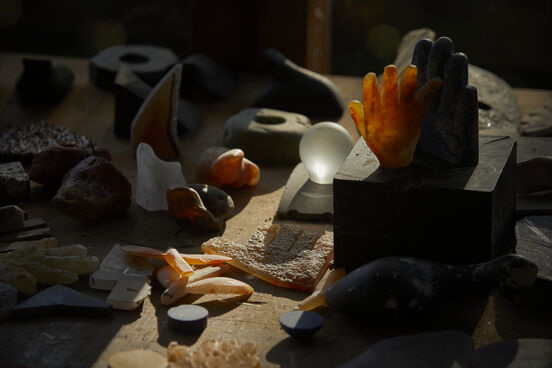
Inside Warwick Freeman's Ngatiranga Bay workshop, 2019, photograph by Sam Hartnett
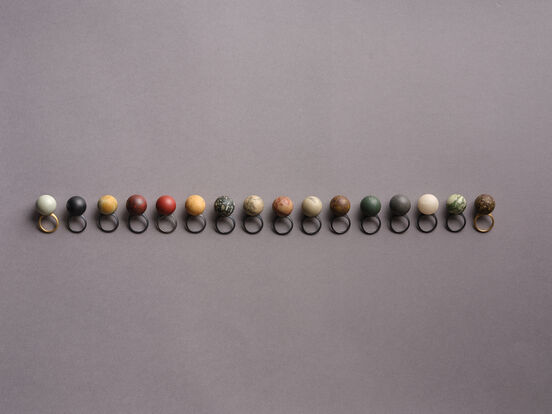
Warwick Freeman, North Cape to Bluff, 2007, photograph by Sam Hartnett
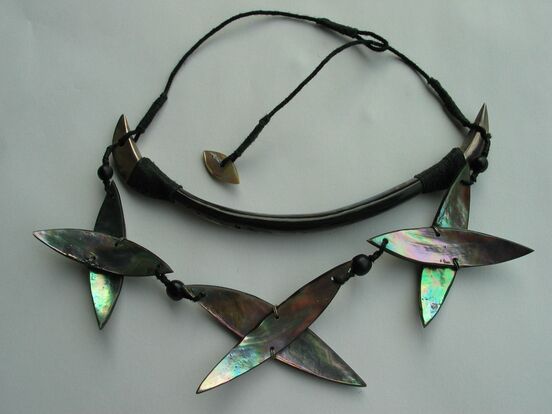
Warwick Freeman, Criss Cross, 1981, photograph supplied
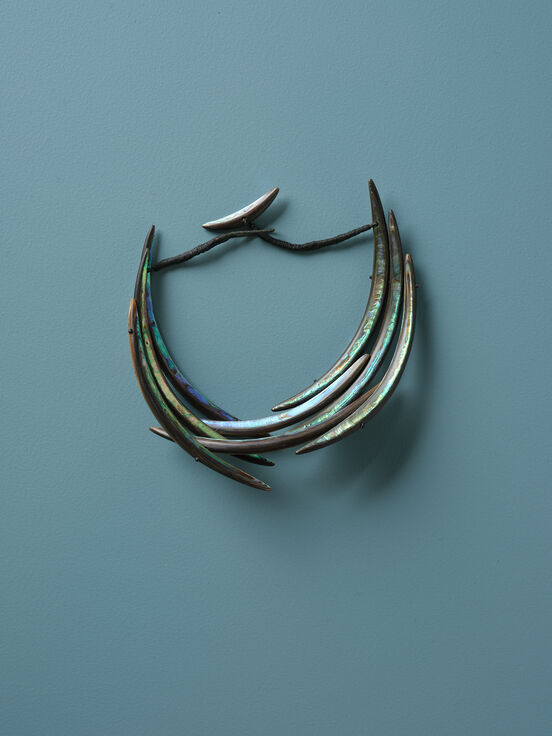
Warwick Freeman, Whitebait Necklace, 1982, photograph by Sam Hartnett
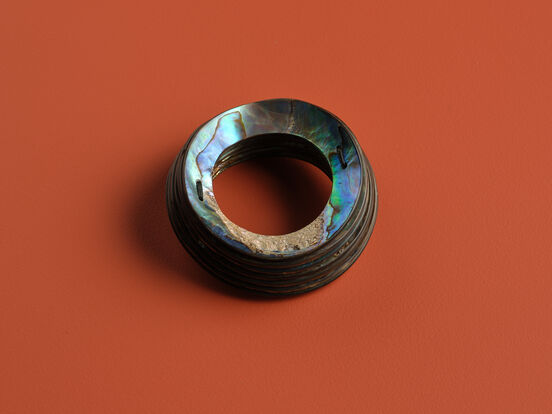
Warwick Freeman, Pāua Layer Bracelet, 1985, photograph by Sam Hartnett
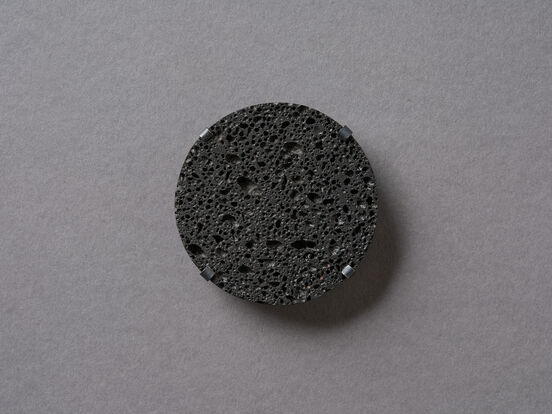
Warwick Freeman, Lava Brooch, 2004, photograph by Sam Hartnett
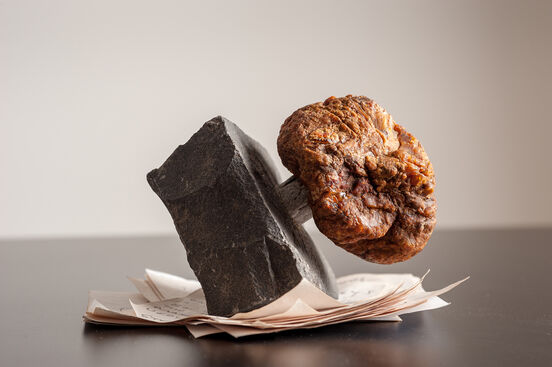
Warwick Freeman, Gumball paperweight, photograph supplied
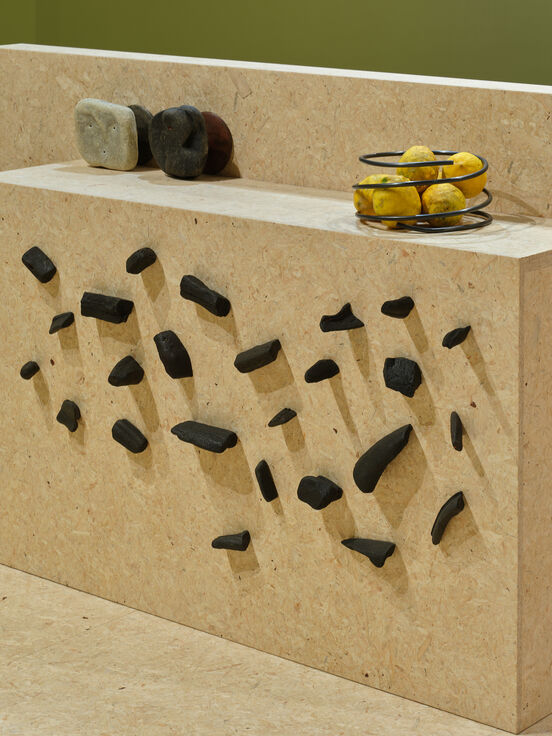
Warwick Freeman, Lava Handles, 2015, installation view in How to make a home, 14 Sep–17 Nov 2024, Objectspace, photograph by Sam Hartnett
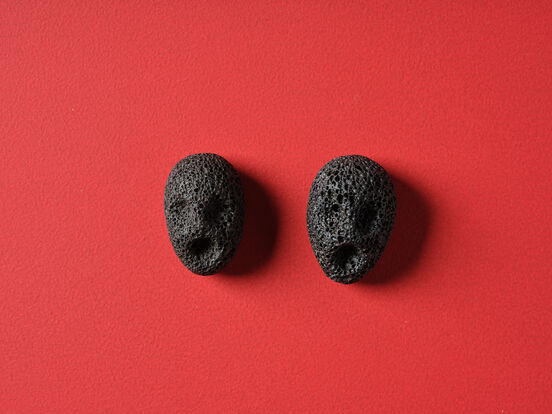
Warwick Freeman, Fella Brooches, 2004, photograph by Sam Hartnett
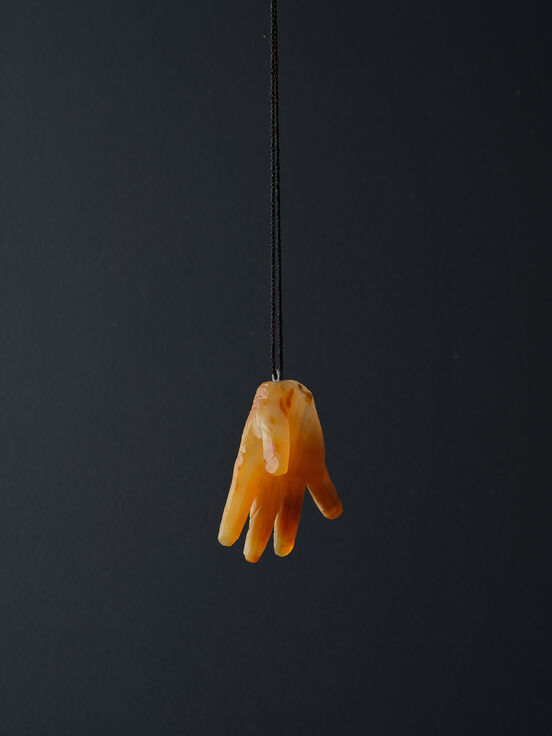
Warwick Freeman, Helping Hand, 2024, photograph by Sam Hartnett