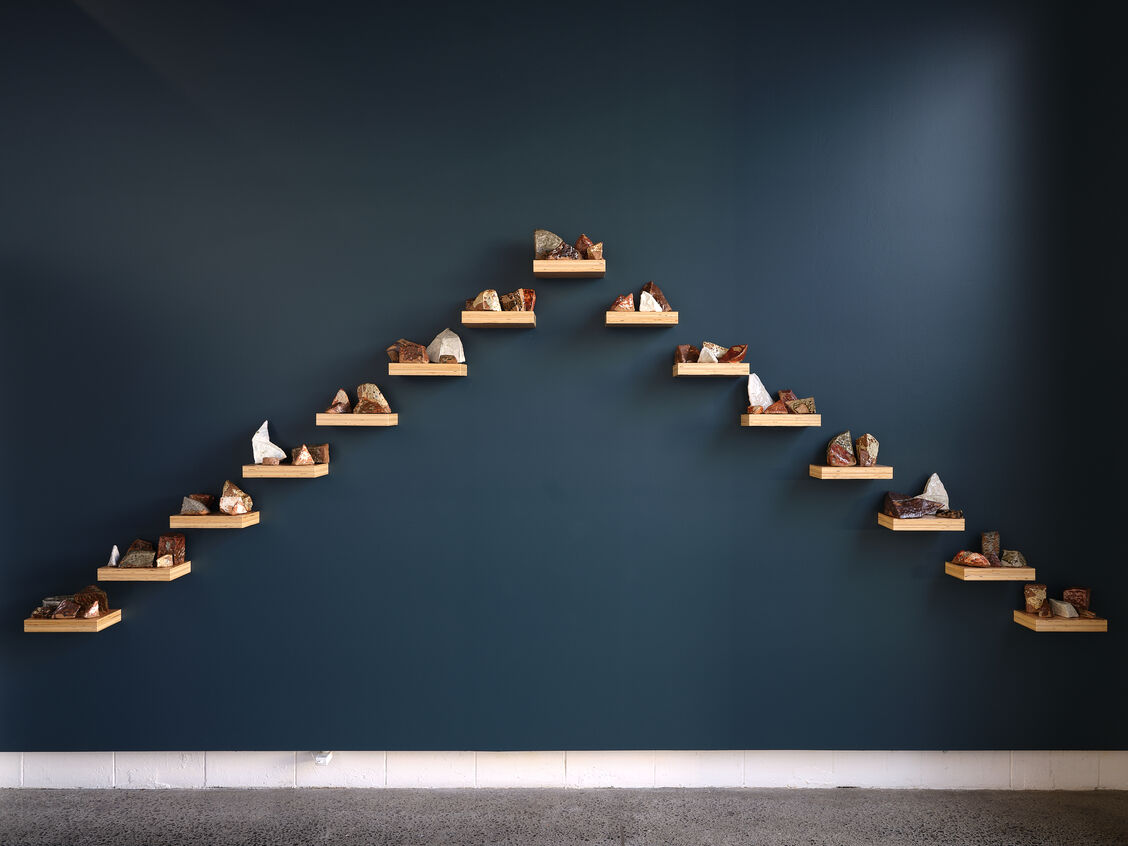
We used to be a mighty mauka is the second in a series of short-run exhibitions in Objectspace’s foyer. Three ceramics practitioners have been invited to show recent work over this season, offering an insight into diverse ceramics practices in Aotearoa.
We used to be a mighty mauka plays with the commonalities between the Māori belief that we are born from the land (and shall one day return to it) and the geological lifecycle of ceramics. Drawing inspiration from taoka pūoro; the rattle rocks of Waitaki; and aspects of their studio practice, Nicholson acknowledges the mauri of their materials:
The call of clay slaking down – hissing and bubbling as it gossips away – returning to a suspended particle before settling; the haunting karaka of the pōhatu as its voice rattles in response; all culminating in a pōwhiri to welcome us into the soil of our bones.
The exhibition invites visitors to explore the sounds of the rocks made by Nicholson by giving them a gentle rattle.
Recently shown at CoCA Toi Moroki in Ōtautahi Christchurch, the work is reconfigured at Objectspace in a poutama layout, a symmetrical stepped tohu used in toi Māori to symbolise genealogies and movement towards knowledge and enlightenment. Here, the tohu is used by Nicholson to express the particular type of knowing they gain from physically being on whenua, getting to know the ways te taiao has informed their cultural identity and interacting with materials at the source. Poutama, often used in whakairo, brings to mind here the ana whakairo practice of Kāi Tahu iwi – where whakairo does not describe carving, but adornment.
Adorning the walls of Objectspace, Nicholson's rattle rocks share some of the aspects of Kāi Tahu whenua and practice that make the iwi unique. Accompanying the installation is an audio landscape, Ka maumahara te uku – an eight minute recording of uku from Maukatere, Grey River, and Rakahuri awa slaking down in water.
—
Glossary of te reo
Māori kupu in text:
Karaka – call
Pōhatu – stones
Pōwhiri – welcome
Taoka pūoro – instruments
Tohu – symbol
Toi Māori – Māori art
Whenua – land
Te taiao – natural world
Whakairo – carving
Ana whakairo – rock/cave art
Uku – clay
Awa – river
—
Jess Nicholson (Waitaha, Kāti Māmoe, Kāi Tahu, Pākehā) is a ceramic artist and pottery teacher based in Ōtepoti Dunedin. Their practice is grounded in Kāitahutaka and environmental sustainability. They consider the transitional and non-linear nature of re/connecting to whakapapa by transforming local, collected, and reclaimed materials (uku, pōhatu, oneone, ash, ceramic and glass) into ceramic forms that act as a metaphor for the self. In 2025 they exhibited with Paemanu: Ngai Tahu Contemporary Visual Art Collective at the 11th Asia Pacific Triennial in Meanjin Brisbane, were awarded the Caselberg Creative Connections Residency, exhibited Re: Wild/Mohoao/Gwyllt in Pōneke Wellington, received second place at the ILT Arts Murihiku awards and a Merit Prize at the Portage Ceramic Awards.
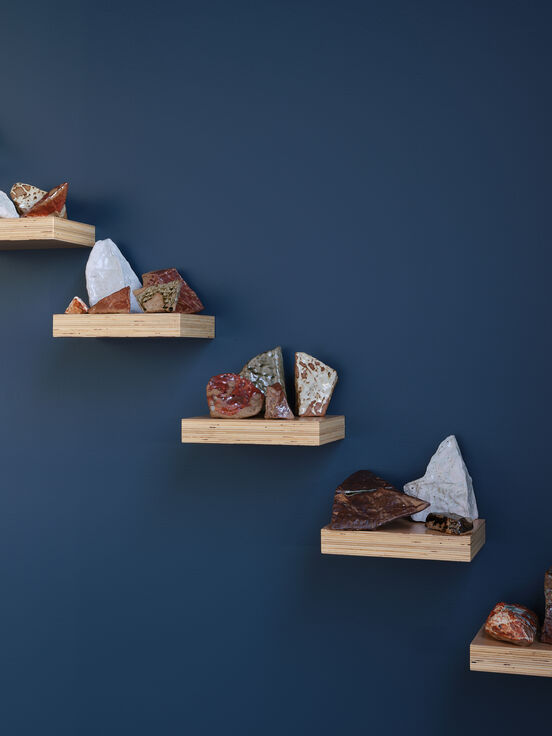
Installation view, Jess Nicholson, We used to be a mighty mauka, 2026, Objectspace, photograph by Sam Hartnett
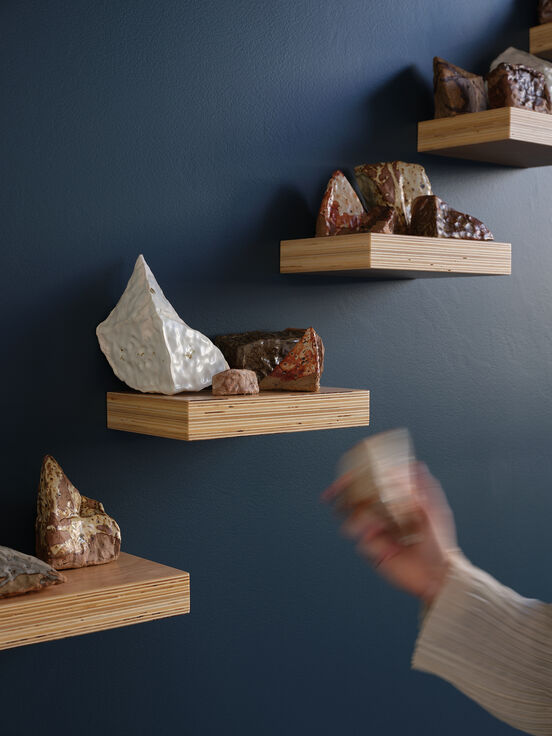
Installation view, Jess Nicholson, We used to be a mighty mauka, 2026, Objectspace, photograph by Sam Hartnett