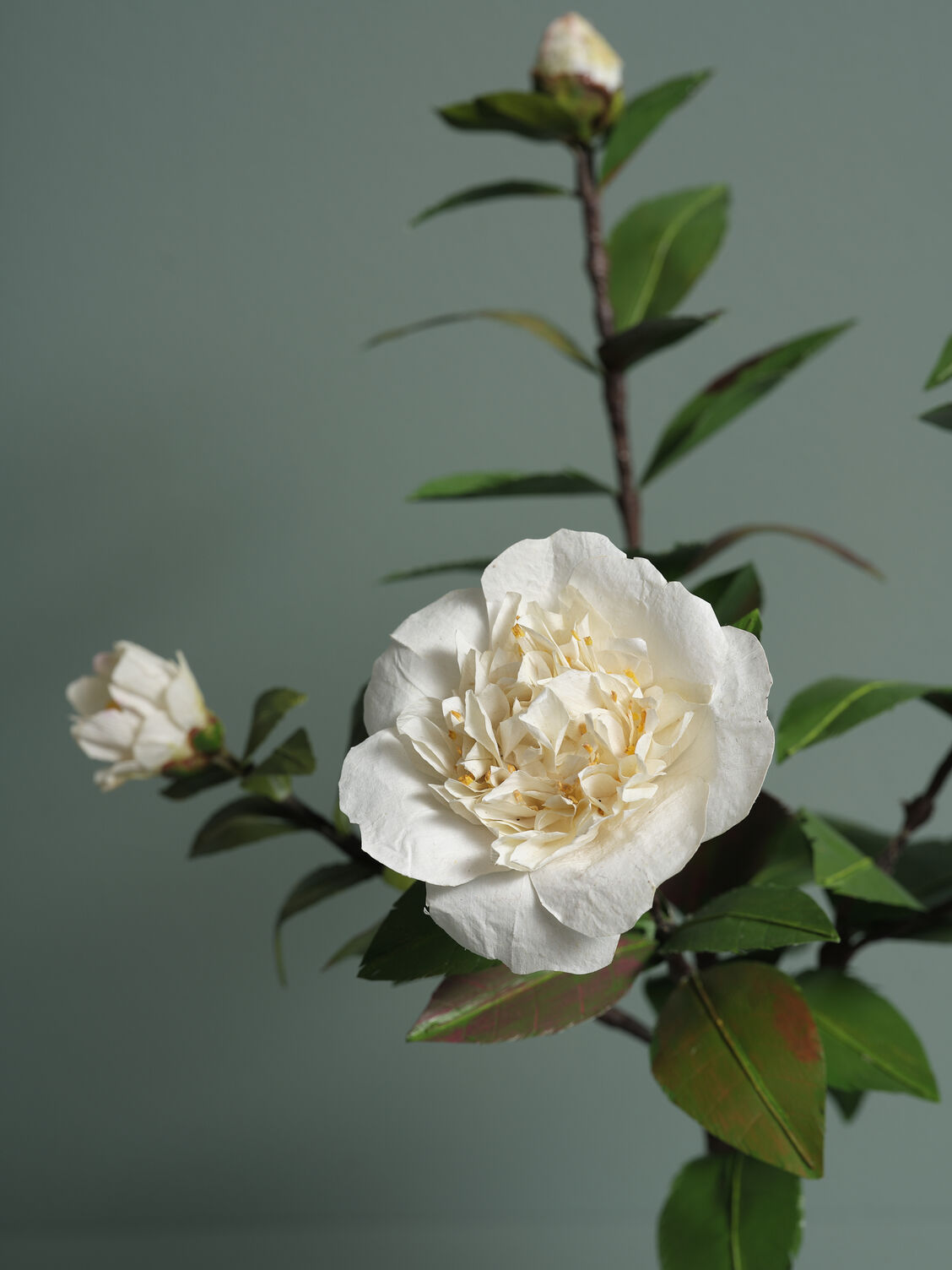
The Camellia Society foregrounds Karin Montgomery’s fascination with the long histories of the plants in her garden and their social significance.
These exquisite paper reconstructions of imperfect Camellia japonica and Camellia oleifera specimens are propelled by cultural as much as botanical observation. Camellia Societies flourished in Aotearoa when the flower’s scarcity conferred social status; local conditions, however, suited the camellia so well that by the early twentieth century the former hothouse rarity had become something to expel from the fashionable garden.
The camellia’s colonial entanglement is inscribed in its name. Native to China, Japan, and other parts of East Asia, it was named in the eighteenth century by Linnaeus after Jiří Josef Kamel, a seventeenth-century Czech missionary and naturalist who never saw an example of the genus. The precise date of the flower’s arrival in Aotearoa is unrecorded, though environmental historian James Beattie notes more than fifty varieties populating prosperous settlers’ gardens by the early 1840s. By 1893, this once-rare ornamental acquired a powerful symbolic role, when the women’s suffrage movement presented white ‘Taranaki’ camellias to parliamentarians supporting the vote.
The exhibition, installed within Miles Warren’s masterpiece of Christchurch Modernism, situates the camellia within the moment it became unremarkable. Near the gallery entrance is a double-ended Kauri sofa thought to have been made at Te Waimate Mission House around 1834 – the time in which the country’s oldest surviving camellias were planted at the Waitangi Treaty Grounds by Agnes Busby.
Montgomery has also inserted native species among the exotics. The Manuka and Kōwhai are held aloft in ornately scaffolded vases by Richard Stratton. His lost-in-translation riffs on Chinese ware are a reminder of the cultural obfuscation of the Camellia’s Chinese origins. The Manuka sits atop a c.1855 cedar and kauri chiffonier; the Kōwhai occupies a c.1875 starburst marquetry specimen table by Christchurch firm, W.H. Jewell. The colonial furniture in the exhibition is from the collection of historian Dr William Cottrell.
Few visitors will miss the actual camellia out the window in the Japanese-influenced garden Warren established in 1962. Camellias also feature in Warren’s subsequent garden, Ohinetahi, begun in the late 1970s on the remnants of a garden developed a century earlier by botanist, ornithologist and one of New Zealand’s earliest conservationists, Thomas Potts.
Montgomery’s enthralling craft returns the wonder to common species and invites us to reflect more on the complex histories in our own backyards.
—
Karin Montgomery’s exceptional craft reflects her attentiveness to the ecology of her garden and immediate inner-city neighbourhood. Her art has its origins in a time of pandemic lockdown but its foundations are in earlier aesthetic experience. For many years she worked as a textile importer, kept bees in her garden and developed an appreciation of botanical art including Mary Delany’s eighteenth-century ‘paper mosaicks’ and Fanny Osborne’s studies of native flora made at the end of the nineteenth-century on Aotea Great Barrier Island. Montgomery has researched the history of plant migration, whaler gardens in Aotearoa and the Chinese origins of ubiquitous species. She has received commissions from Ngā Kohina Taonga Whakahirahira Auckland Libraries Special Collections and Te Papa Tongarewa Museum of New Zealand.
—
The Camellia Society was first exhibited at Objectspace in Tāmaki Makaurau Auckland from 28 Jun–24 Aug 2025. Thanks to Anna Miles for her curatorial input on the show’s Ōtautahi showing, and to The Arts House Trust, Ōhinetahi Charitable Trust and private lenders.
Our gratitude to the Boosted supporters who have made this exhibition possible – along with the preceding show Pleasure Garden and a pondside event series – and to match-funders Rātā Foundation, Creative New Zealand and Christchurch City Council. Thanks to:
Ros Burdon, Ambitec, Julianne Liebeck, Roberts Gray Architects, Mahi Toi, Alison O'Connell, Janet Blackman, Angela Dobbs, Anna Ryan, Emma + Tessa, Judith Knibb, Anke Richter, Rebecca Stewart, Kate Burtt, Heritage Works, Pip Voller, Annie Pokel, Morrin Rout, Kristin Stephenson, Alice Lines, Emma Wallbanks, Jamie Teheuheu, Kent Gardner, Jenny Harper, Jess Brown, Margaret Forward, Paul Roper-Gee, Holly Neave, Amelia Fagence, Mel Haskell, Charlotte Bell, Lydia Hannah Thomas, Wendy Clarke, Abigail Hau, Sharnaé Storm, Hayley Walmsley, and all those who wished to remain anonymous.
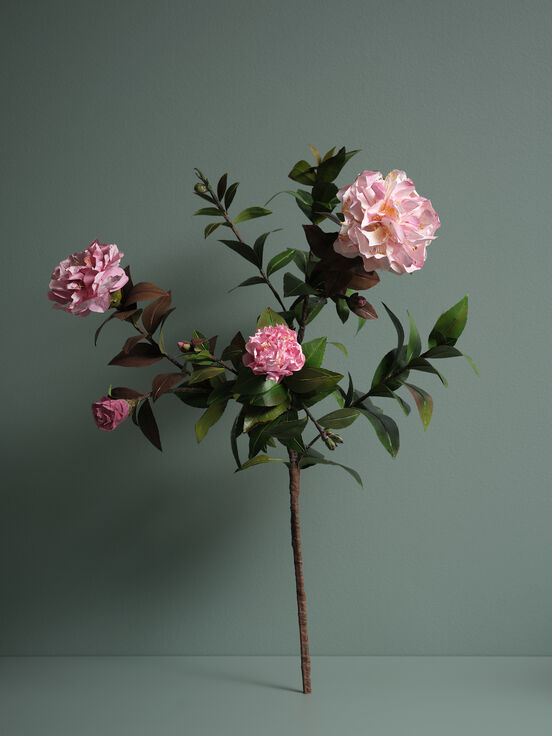
Karin Montgomery, Camellia Japonica, Common Camellia, Rose of Winter, 2025, photograph by Sam Hartnett
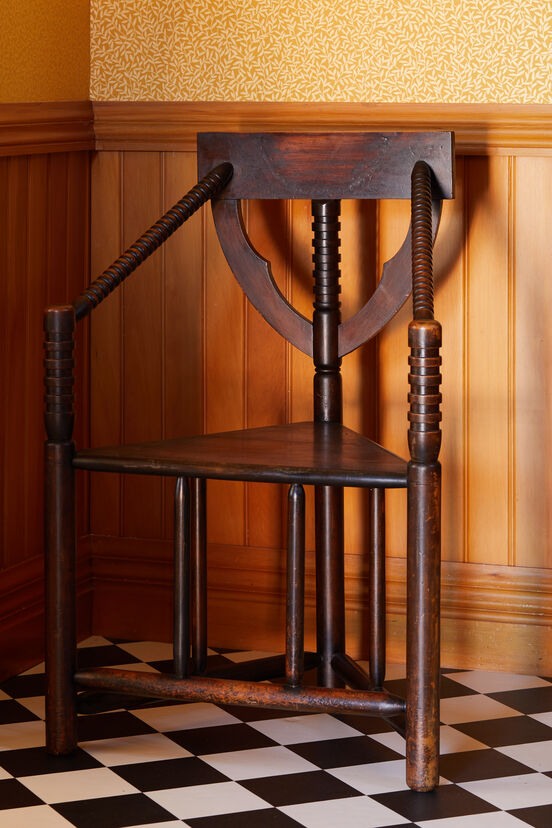
Maker unknown, Turner’s Chair, c. 1885-95, collection of Dr William Cottrell, photograph by Sarah Rowlands
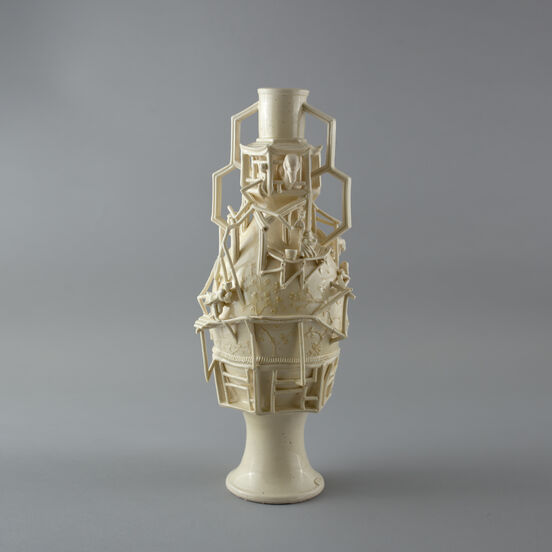
Richard Stratton, Where are the cows?, 2012, photograph by Sam Hartnett