During the pandemic, a focus on how we could happily live and work in smaller spaces became a critical issue. Along with cultural trends (like Marie Kondo), a burgeoning housing crisis, and a growing impetus to live with minimal environmental impact, a trend has come to the fore for architectural designs that reject expansive living in favour of condensed, highly functional spaces (that can still spark joy).
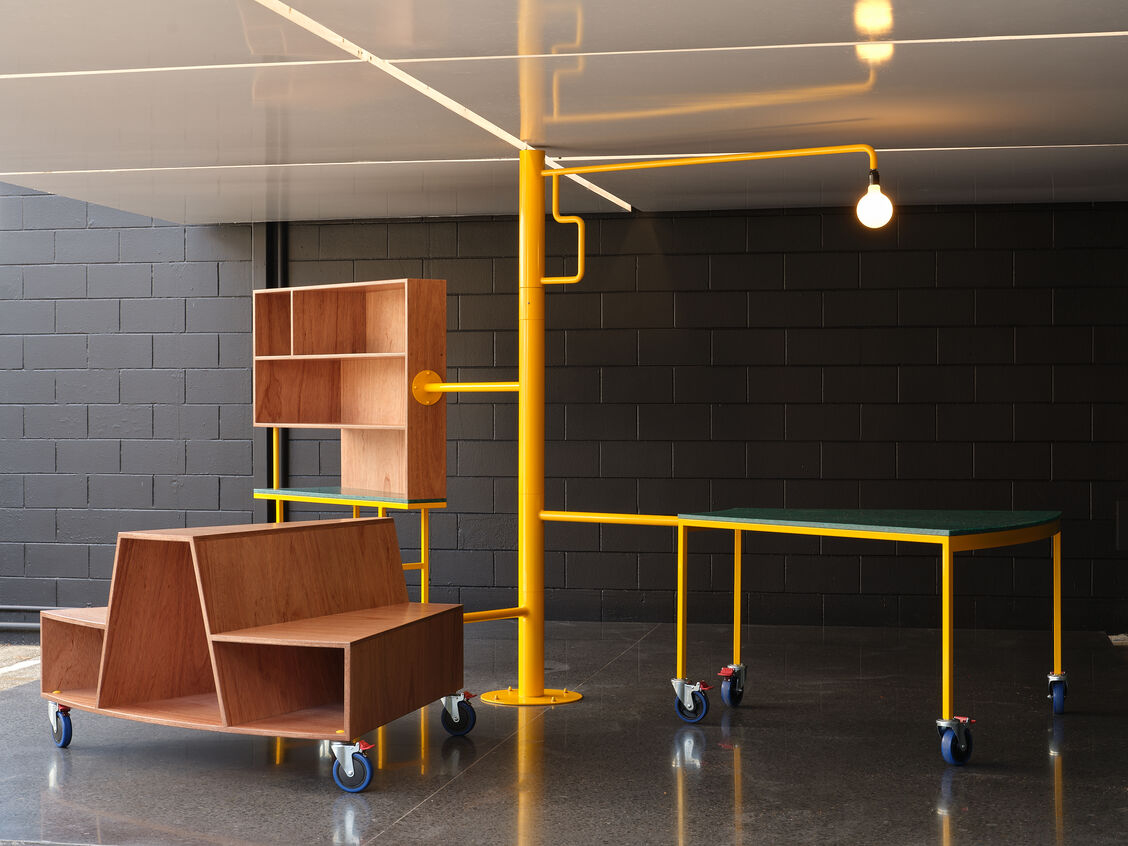
Motivated by Tāmaki Makaurau Auckland’s relatively poor density score and our fraught proclivity for suburban sprawl, Raimana Jones’ design ethos is centred on multi-functional pieces designed with intention – furniture as mini-infrastructure. For the Objectspace courtyard, Jones has designed a tiny space that can function as a dining room, work study, and social gathering point.
On a recent trip to Japan, Jones encountered the concept mottainai, meaning ‘no waste,’ which is reflected in Japanese architecture and everyday living. Sparsely furnished rooms with sliding partitions offered flexible living spaces that could be easily adapted to different functions. Jones noted the way that even the train lavatories were designed with this no-waste concept in mind, integrating soap, water, and hand-drying into a single unit.
Pivot responds to this philosophy through a system that unifies architectural structural elements with built-in furniture attached to a central column. The pivoting mechanism lies at the heart of the design: furniture elements rotate outward from the column, transforming the space into a dining area, workspace, or social hub. The system inherently lends itself to curated, guided flexibility (just like Japanese sliding partitions), providing structure while still allowing visitors to adapt and activate the space for different uses.
Responding to the necessity that our living conditions evolve as conditions change, the rotating elements of Pivot draw down from the central column to activate the area, while incorporating Jones’ eye for material combinations, colour and composition. Pivot draws inspiration from domestic and public space to maximise a small footprint and create a playful, mobile intervention for visitors to activate.
—
Jones worked with Alistair Munro (The Alistair Munro Design Company) to deliver Pivot. Munro focussed on the detailed design and fabrication of the plywood and Critical Cleanstone components, to realise Jones’ vision. Munro is a Tāmaki Makaurau Auckland-based designer and maker, with a multi-modal process informed by materiality and collaboration. The production of Pivot was also supported by Steve Brookbanks of Object Support.
—
After pursuing a traditional architecture education followed by the requisite stint working for large architecture outfits, an invitation to teach design studio and technical papers inspired a shift for Raimana Jones. All spare time became filled with hands-on making in the university workshop, fostering a material-led design approach that soon informed Jones’ founding of Atelier Jones Design. In his work, Jones aims to express both the practical and artistic qualities of materials. By embracing the constructive and poetic aspects of the medium at hand, Jones creates furniture, interiors and objects that speak to both his aesthetic and a restrained functionality. Jones is also a Professional Teaching Fellow at the University of Auckland – School of Architecture and Planning.
Objectspace's Courtyard Plinth Commissions are supported by the Jan Warburton Charitable Trust.

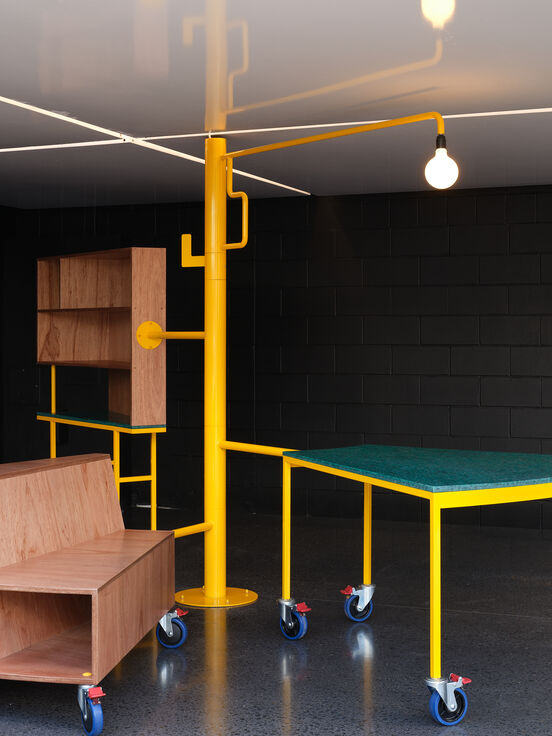
Raimana Jones, Pivot, 2025, photograph by Sam Hartnett

Raimana Jones