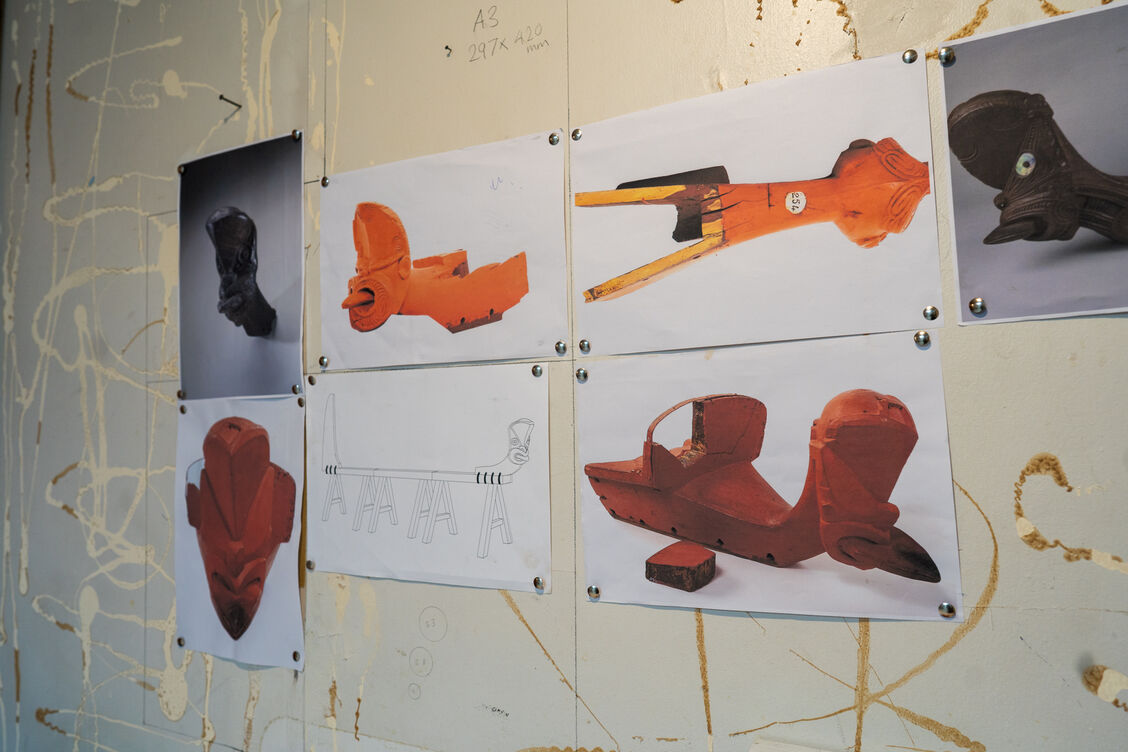
Commissioned by Objectspace as part of the Courtyard Plinth series, Overtime by Chevron Hassett continues the artist's relationship with urban Indigeneity and narratives of migration and labour within Māori histories. Hassett looks to the roles of native timbers in both building and carving traditions and connects these to signifiers of Māori experience and what has enabled or provoked physical and social transitions around the motu.
Using reclaimed timbers from buildings demolished locally, Hassett reinterprets aspects of a waka tētē (single-hulled utility canoe) with a structure ubiquitous to building sites, the sawhorse. The two elements speak to ideas of construction, movement and social mobility.
Having recently completed dedicated study of whakairo following the tradition of carvers in his whānau, Hassett has begun to incorporate carving techniques into his sculptural practice, bridging contemporary materials and processes and formal mātauranga and taputapu (knowledge and tools).
In Overtime, two components, the tauihu (prow carving) and the taurapa (sternpost), are carved by Hassett in the less decorative style found on the waka tētē. Waka tētē were once essential in achieving daily tasks – used for kai gathering, trade and transport. They were integral vessels for everyday life, to complete important mahi in service to whānau and hapū. Here, the carved elements are added to connected sawhorses to create an elongated platform. Combined, Hassett creates a contemporary representative of modern work and a new vessel that he terms waka mahi.
Hassett’s waka mahi conjures ideas of labour and working-class identities – the relentless grind to put food on the table and endurance of long shifts to try to get that little bit ahead. For Hassett, the labour of carving also carries the dedicated time he has given to maintaining and strengthening his cultural identity – a vessel of continuity for the expression of both traditions of the past and realities of present living conditions. At Objectspace, Overtime offers a place to rest, to consider the process of making and the legacy of how we use, shape and put to work the materials around us.
—
Chevron Hassett (Ngāti Porou, Ngāti Rongomaiwahine, Ngāti Kahungunu) is an artist whose practice engages with sculpture, photography and public installation. His work responds to the impact of urbanisation on Māori communities, informed by his own upbringing and community and grounded in the visual and spatial language of Māori design. Working with reclaimed materials and architectural references, Hassett reconfigures forms to speak to ideas of shelter, identity and collective memory. His installations often function as living spaces of exchange, where mātauranga Māori and the urban experience intersect.
Committed to community engagement, Hassett works across galleries and public spaces to reflect the relationships, histories and futures of the people and places he is connected to. His practice centres whanaungatanga (kinship), drawing strength from shared experience and cultural continuity. Hassett holds a Bachelor of Design with Honours from Te Kunenga ki Pūrehuroa Massey University and a diploma in Indigenous Art, specialising in Whakairo Māori. He has exhibited in Aotearoa and Australia, including at Artspace Aotearoa, the Govett-Brewster Art Gallery, The Dowse Art Museum and Artspace Sydney. In 2017 he received a Ngā Manu Pīrere award from Creative New Zealand, and in 2022 a Springboard Award from the Arts Foundation Te Tumu Toi.
Objectspace's Courtyard Plinth commissions are supported by the Jan Warburton Charitable Trust.

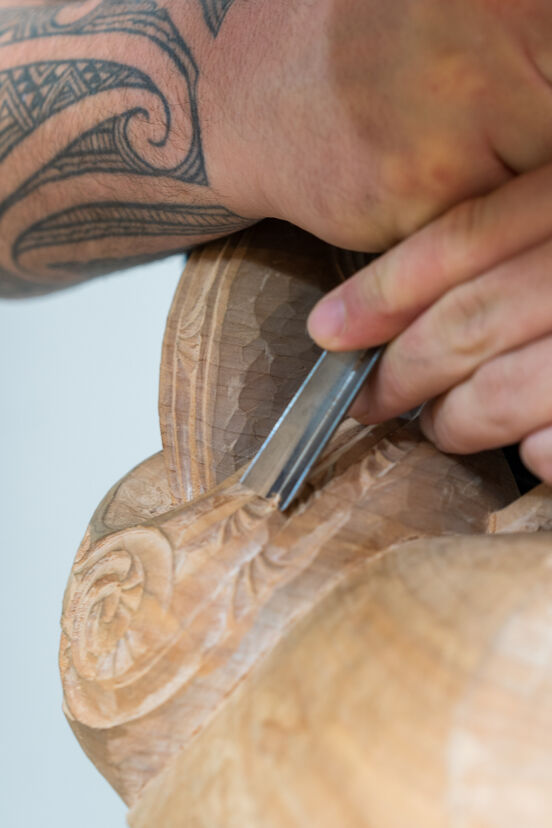
Chevron Hassett carving in the studio, photograph by Edith Amituanai
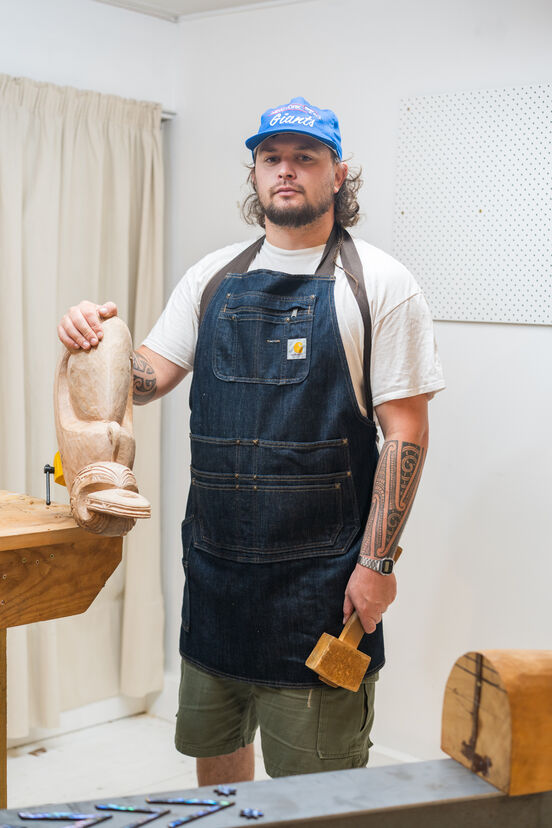
Chevron Hassett, photograph by Edith Amituanai